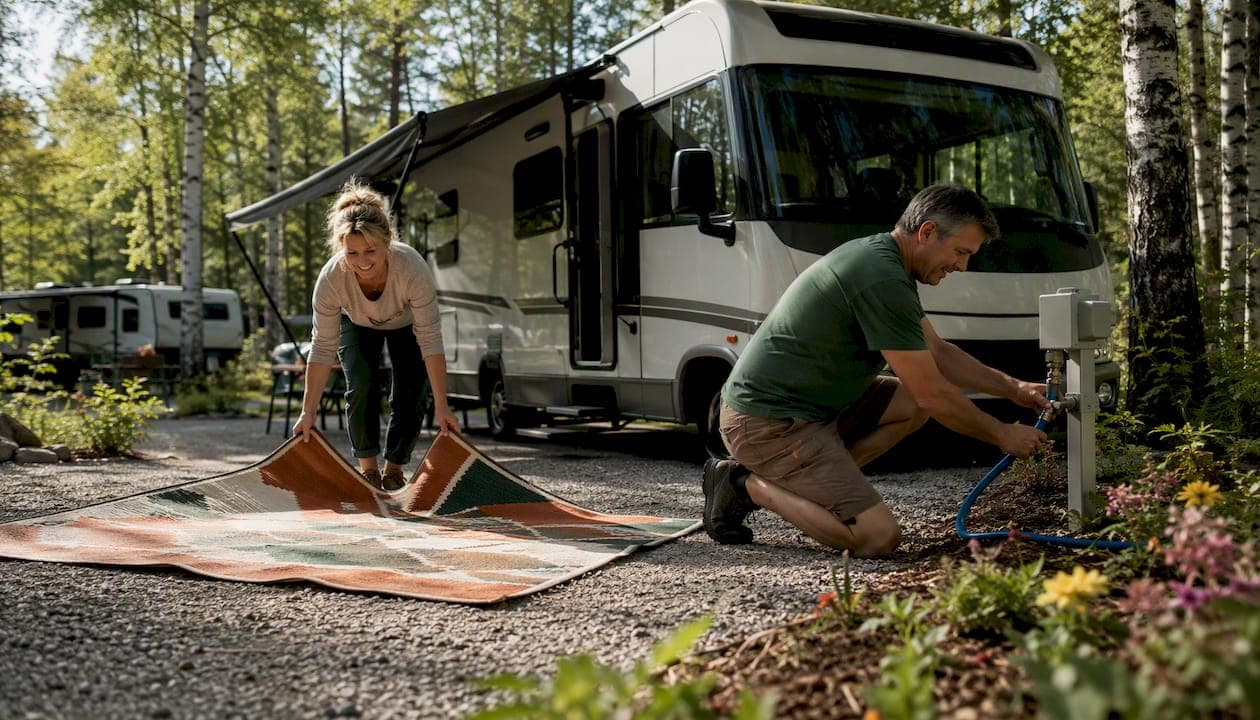
A full-hookup campsite delivers water, sewer, and electrical connections directly at your site — no dump station runs, no rationing your fresh tank, no morning hike to the bathhouse. If you're ready to find one now, filter for "full hookups" in Campgazer and confirm two things before you book:
- Electrical amperage: Does the site offer 30-amp, 50-amp, or both? Match this to your rig's shore power inlet.
- Site length and type: Is it a pull-through or back-in? What's the maximum rig length the pad accommodates?
Pro Tip: When you're in a hurry, call the campground directly. Ask specifically about seasonal water availability and whether the pad is concrete or gravel — listing photos don't always tell the full story.
Table of Contents
- What does "full hookup" actually mean for your RV?
- Where you'll find full-hookup sites across the U.S.
- How to evaluate and choose the right full-hookup campsite
- What do full-hookup sites typically cost?
- How to find and filter full-hookup campgrounds with Campgazer
- Key Takeaways
- The detail that most campers skip until it's too late
- Campgazer makes finding full-hookup RV sites faster
- Useful sources and further reading
What does "full hookup" actually mean for your RV?
Full-hookup sites provide on-site water, sewer, and electrical connections, which means you can run your rig the way you'd run a house: normal bathroom use, longer showers, a plugged-in air conditioner, and a connected water line without touching your holding tanks. For stays longer than a night or two, that convenience is hard to overstate.
The contrast with other hookup types is practical and immediate:
- Water and electric only (W/E): You get shore power and a water connection, but no sewer. You'll still need to manage your gray and black tanks and visit a dump station before you leave.
- Electric only: Power at the site, but you're hauling water and managing all tanks independently.
- No hookups (dry camping or primitive): Self-contained operation. Your tanks, your generator or solar, your water supply.
Electrical specs: 30-amp vs. 50-amp
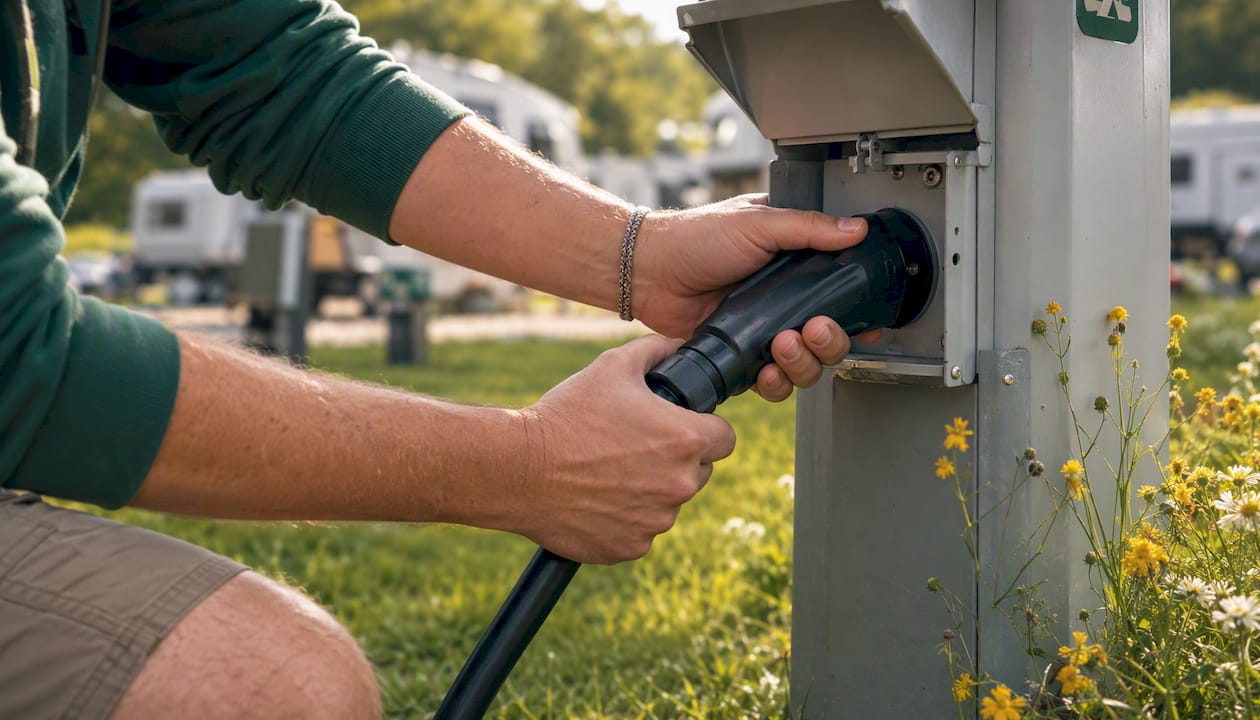
Most full-hookup sites offer 30/50-amp service, but not always both. A 30-amp connection runs on a single 120-volt leg and limits you to roughly 3,600 watts — enough for a smaller rig with one air conditioner. A 50-amp connection runs on two 120-volt legs for up to 12,000 watts, which is what larger fifth wheels and Class A motorhomes typically need to run dual ACs, an electric water heater, and a microwave simultaneously.
Before you book, run through this short compatibility check:
- Identify your rig's shore power inlet (30-amp TT-30 plug or 50-amp 14-50 plug).
- Pack a 30-to-50-amp or 50-to-30-amp dogbone adapter so you can use either pedestal.
- Bring a surge protector rated for your amperage — campground power quality varies.
- Confirm your sewer hose length and fittings (a 20-foot hose covers most connection distances).
- Check water pressure: many campgrounds run high pressure, so a regulator protects your lines.
Pro Tip: Water pressure at campgrounds can spike above 80 PSI. A simple inline pressure regulator — under $20 at most RV supply stores — protects your hoses and fittings from blowouts.
Where you'll find full-hookup sites across the U.S.
Not every campground offers full hookups, and the ones that do vary widely in what else they provide. Knowing which category of park to target saves you from filtering through dozens of listings that don't fit.
Private RV resorts are the most reliable source of full-hookup sites. They're built for RVers, so pull-throughs, 50-amp service, concrete pads, and long-site options are common. Resort listings frequently advertise full-hookup sections alongside amenities like heated pools, laundry facilities, and family programming — the hookups are the baseline, and the resort experience is the draw.
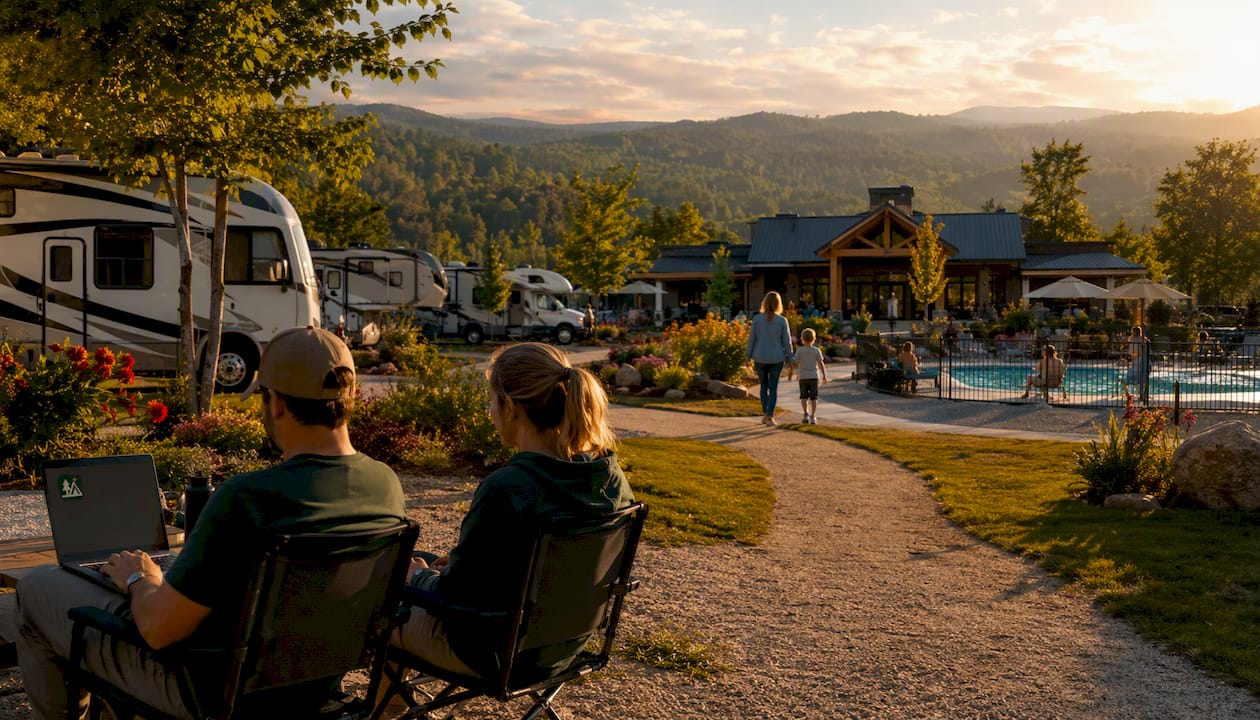
KOA campgrounds sit in a middle tier: more amenities than a basic county campground, more consistent hookup specs than a mom-and-pop park. Many KOA locations offer full hookups with 30/50-amp service, and their listings are detailed enough that you can usually confirm site length and amperage before booking. You can browse KOA site specs directly on Campgazer's KOA listing to see how hookup details appear in a standardized format.
Family-oriented resort campgrounds — including Jellystone Park locations — lean into the full-hookup model because removing utility management tasks lets families spend more time in on-site activities. When you're not worrying about tank levels, you're at the pool or the jumping pillow. That's the point.
State park campgrounds are where expectations need calibrating. Some state parks offer full hookups — California State Parks, for example, lists hook-up and RV camping options with site-level detail — but many public campgrounds only provide water and electric, or offer full hookups in a limited section of the park. State park facility pages often note which sites have sewer and flag which hookup types are available only during the on-season, so read those pages carefully.
Here's a quick way to match your vacation style to the right provider type:
- Big rig, full amenities: Target private RV resorts or KOA RV resorts. Confirm pull-through length (some go up to 100 ft) and 50-amp availability.
- Family trip with kids: Jellystone Park locations and resort-style private campgrounds offer programming alongside hookups — a combination that makes the campground itself the destination.
- Nature-focused stay near a park: Check state park campground pages directly, then verify hookup type and seasonal availability before booking.
- Budget-conscious: State parks often price full-hookup sites lower than private resorts, though availability is tighter and amenities are fewer.
Pro Tip: Pad surface matters more than most campers expect. Concrete slabs keep your rig level and clean on extended stays; gravel pads can shift. If you're staying more than two nights, ask specifically about pad material when you call.
| Provider type | Full hookup reliability | Typical site length | Amenity level | Best for |
|---|---|---|---|---|
| Private RV resort | High | Up to 100 ft | High (pool, laundry, dining) | Big rigs, resort-style stays |
| KOA campground | High | Varies by location | Medium-high | Consistent specs, chain reliability |
| Jellystone / family resort | High | Medium-large | High (programming, activities) | Families with kids |
| State park campground | Variable | Varies | Low-medium | Nature access, lower cost |
How to evaluate and choose the right full-hookup campsite
Filtering for "full hookups" narrows the list. Choosing the right site from that list takes a second pass. Work through this checklist before you commit to a reservation:
- Site length: Confirm the maximum rig length the site accommodates. A 40-foot fifth wheel needs more than just a sewer connection — it needs clearance.
- Pull-through vs. back-in: Pull-throughs are easier for solo drivers and big rigs. Back-ins can be tighter, especially in older campground layouts.
- Amperage: Verify 30-amp or 50-amp availability for your specific site, not just the campground in general.
- Pad surface: Concrete or gravel? For stays of three or more nights, concrete is worth seeking out.
- Sewer connection location: The cleanout should be near the rear of your rig. Some sites place it at the front of the pad, which means a longer hose run.
- Water pressure: Ask if the park uses pressure regulators at the pedestal or if you need your own.
- Pet and accessibility policies: Some full-hookup sections restrict pets or have specific leash rules. ADA-accessible sites are often designated separately.
- Generator hours: Most campgrounds restrict generator use to daytime hours (typically 8 AM–10 PM). If you rely on a generator as backup, confirm the window.
Once hookups are confirmed, shift your attention to the experience layer. Campground operators consistently note that hookups are foundational but not the sole value driver — cleanliness, staff responsiveness, Wi-Fi reliability, laundry access, and playgrounds all shape whether a stay feels like a vacation or just a parking spot. For families, on-site programming can be the deciding factor between two otherwise similar parks.
Booking risk factors deserve attention too. Peak-season surcharges, holiday weekends, and rally events can push rates up and availability down. Mid-week stays typically cost less and offer more site selection. Flexible cancellation policies matter when your travel dates might shift — read the fine print before you pay.
Pro Tip: Some campgrounds shut off water and sewer lines in winter, so a site listed as "full hookup" in summer may only provide electricity from November through March. Always confirm season-specific hookup availability before arrival.
What do full-hookup sites typically cost?
Nightly rates for full-hookup sites vary by region, provider type, and season. As a reference point, state park listings show on-season rates ranging from $38/night for a full-hookup non-waterfront site to $42/night for a full-hookup waterfront site, compared to $24/night for a water-and-electric-only waterfront site at the same park. Private resorts and KOA locations generally run higher, with many starting around $59/night and climbing well above that during peak season.
Key factors that move the price:
- Season and demand: Summer weekends, holiday weekends, and local rally events push rates up. Shoulder seasons (May, September, October) often offer the same hookups at meaningfully lower rates.
- Site position: Waterfront, pull-through, and premium sites carry a surcharge at most parks.
- Membership programs: State park annual passes, KOA Value Kard Rewards, and campground membership clubs (such as Thousand Trails or Passport America) can reduce nightly rates or unlock better cancellation terms.
Reservation lead times matter as much as price. Popular full-hookup resorts near national parks or coastal destinations can book out months in advance for peak summer weekends. A practical approach: book your anchor nights (Friday and Saturday) early, then add mid-week nights closer to your trip when availability opens up. Use availability alert features — Campgazer offers these — to catch cancellations at high-demand parks.
How to find and filter full-hookup campgrounds with Campgazer
The fastest way to locate RV campgrounds with full hookups is to use a search tool that filters by hookup type and rig specs simultaneously. Here's how the Campgazer workflow runs:
- Set your rig specs in your Campgazer profile (rig length, slide-outs, amperage requirement). The platform uses these to surface compatible sites automatically.
- Filter for "full hookups" in the campground search. This removes water-and-electric-only and dry-camping sites from your results.
- Confirm amperage and site length on the individual campground page. Campgazer's listings include amenity details pulled from park data and community contributions.
- Read community notes and photos. User-submitted photos and trip reports often show the actual pad surface, pedestal condition, and site spacing — details that official listings sometimes omit.
- Enable availability alerts for your target dates. When a site opens up at a high-demand park, you'll get notified rather than having to check manually.
- Save stops to your trip itinerary with backup options flagged. The trip planner lets you build a multi-stop route and note which sites are confirmed vs. waitlisted.
Alternative discovery methods each have trade-offs:
- Official state park directories (like California State Parks' RV camping page) are authoritative for hookup type and seasonal rules, but they rarely filter by rig length or amperage.
- Calling the park directly is the most accurate method for confirming current conditions — pad surface, water availability, and whether a specific site is actually open. It's slow but reliable.
- General booking portals offer broad inventory but often lack rig-specific filters and may not flag seasonal hookup shutoffs.
| Discovery method | Hookup visibility | Rig-specific filters | Real-time alerts | Trust signal |
|---|---|---|---|---|
| Campgazer | Full hookup filter + amperage | Yes (rig length, amp) | Yes | Community photos + park data |
| State park directory | Listed by site | No | No | Official/primary source |
| Direct phone call | Confirmed by staff | Yes (ask directly) | No | Highest accuracy |
| General booking portal | Basic hookup type | Limited | Varies | Operator-submitted |
Pro Tip: Use Campgazer's trip planner to layer multiple filters at once — hookup type, pad surface, pull-through availability — and save itinerary stops with backup campgrounds noted. It's the difference between a plan and a contingency.
For a real example of how site specs appear in the platform, the Kerr Lake State Recreation Area listing on Campgazer shows how hookup details, pad type, and amenities display in a standardized format. If you're planning a longer route, the RV trip planning guide on the Campgazer blog covers routing, booking sequencing, and lead-time strategy in detail.
Key Takeaways
Booking a full-hookup RV site comes down to three things: confirming the right electrical amperage, verifying site length and pad type, and reserving early enough to get your preferred dates.
| Point | Details |
|---|---|
| Full hookup definition | Water, sewer, and electrical (30A or 50A) at your site — no dump station required. |
| Top three booking checks | Confirm amperage, site length/type (pull-through vs. back-in), and seasonal water availability before paying. |
| Reservation timing | Book peak-season weekends months in advance; use availability alerts to catch cancellations at high-demand parks. |
| Electrical compatibility | Match your rig's shore power inlet to the site's amperage; carry a dogbone adapter and surge protector. |
| Find sites with Campgazer | Use Campgazer's full-hookup filter and rig-spec settings across 10,000+ campgrounds to surface compatible sites fast. |
The detail that most campers skip until it's too late
Here's something worth saying plainly: the label "full hookup" on a listing is a starting point, not a guarantee. Water lines go seasonal. Sewer cleanouts end up at the wrong end of the pad. A 50-amp pedestal turns out to be 30-amp when you arrive. These aren't rare edge cases — they're common enough that experienced RVers treat the phone call as a non-negotiable step, not an optional one.
What I've seen, working with campground data across thousands of listings, is that the gap between what a listing says and what a site actually delivers is widest at public campgrounds and narrowest at well-run private resorts. That's not a knock on state parks — they offer access to landscapes that private resorts can't match. But their listing infrastructure is older, their seasonal rules are more complex, and their staff turnover means the person who updated the website last spring may not be the person answering the phone today.
The practical takeaway: use a good filter tool to build your shortlist, then verify the two or three details that matter most for your specific rig with a direct call. That combination — digital filtering plus a two-minute phone call — catches almost every mismatch before it becomes a problem at check-in.
Campgazer makes finding full-hookup RV sites faster
Searching for camping sites with full utilities across dozens of park websites is the part of trip planning that eats your afternoon. Campgazer pulls 10,000+ campgrounds into one searchable database, lets you filter by hookup type, set your rig's length and amperage requirements, and read community-contributed photos and notes — all before you pick up the phone.
For families, the best family campgrounds guide on the Campgazer blog pairs well with the hookup filter to find resorts that combine full utilities with pools, playgrounds, and on-site programming. For solo travelers or couples who want reliable connectivity at their site, the campgrounds with Wi-Fi resource layers that filter on top of hookup availability.
When you're ready to search, start your campground search on Campgazer and set your rig specs first — the platform will do the heavy lifting from there.
Useful sources and further reading
- Hook-up and RV Camping — California State Parks: Official state park RV camping page listing hookup types, site categories, and seasonal availability rules.
- Lake Shawnee Campground Facilities: State park facility page showing per-site hookup details, on-season rates, and sewer availability by section.
- Trail's End Resort RV Park: Private resort listing with full-hookup site descriptions including water, sewer, and 30/50-amp electrical specs.
- Rush No More RV Sites near Mount Rushmore: Resort listing advertising pull-throughs up to 100 ft, 30/50-amp service, and resort amenities alongside full hookups.
- Camp Jellystone: Family resort operator page explaining how full hookups support resort-style programming and guest experience.
- Pine Acres Family Camping Resort: Operator site with guidance on pad surface differences and the guest-experience factors that matter beyond hookup type.
- Starved Rock Family Campground: Campground page with operator commentary on how full hookups reduce utility anxiety for first-time RVers.
- Campgazer — RV Trip Planner and Campground Search: Search and filter 10,000+ campgrounds by hookup type, rig specs, and amenities; build multi-stop itineraries with availability alerts.
- RV Packing List — Campgazer Blog: Printable checklist covering hookup gear essentials: water hose, pressure regulator, surge protector, sewer hose, and adapters.