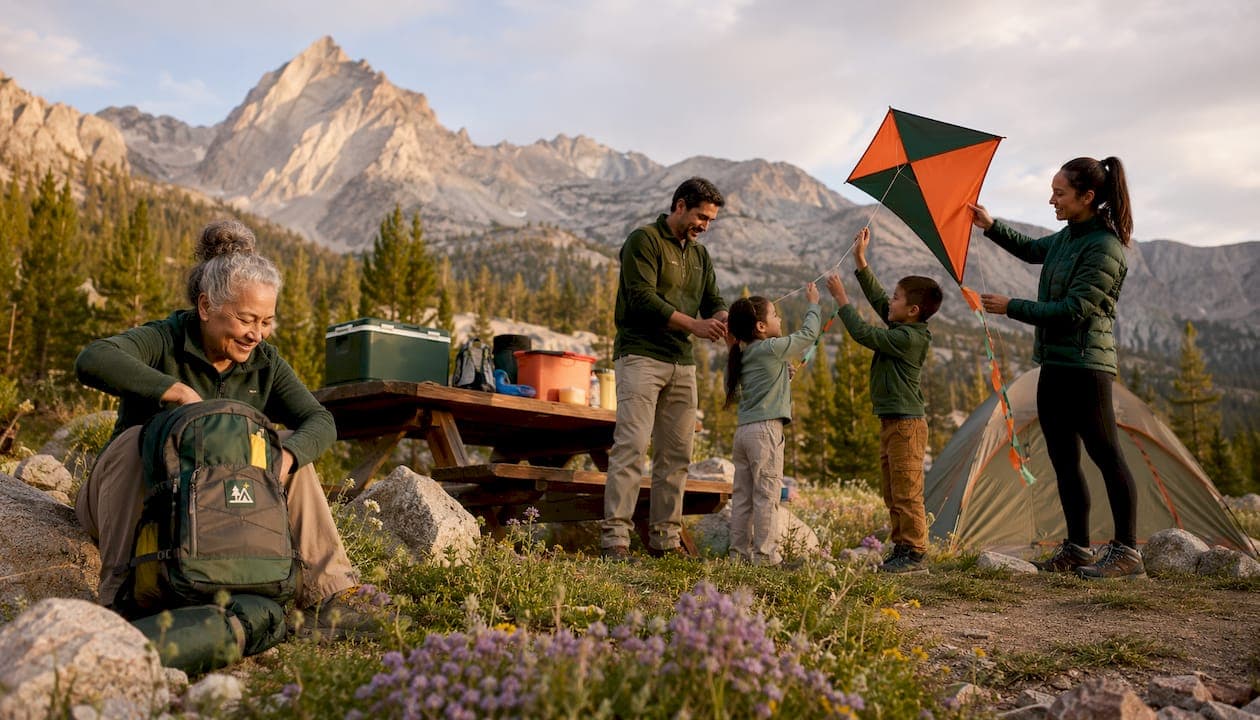
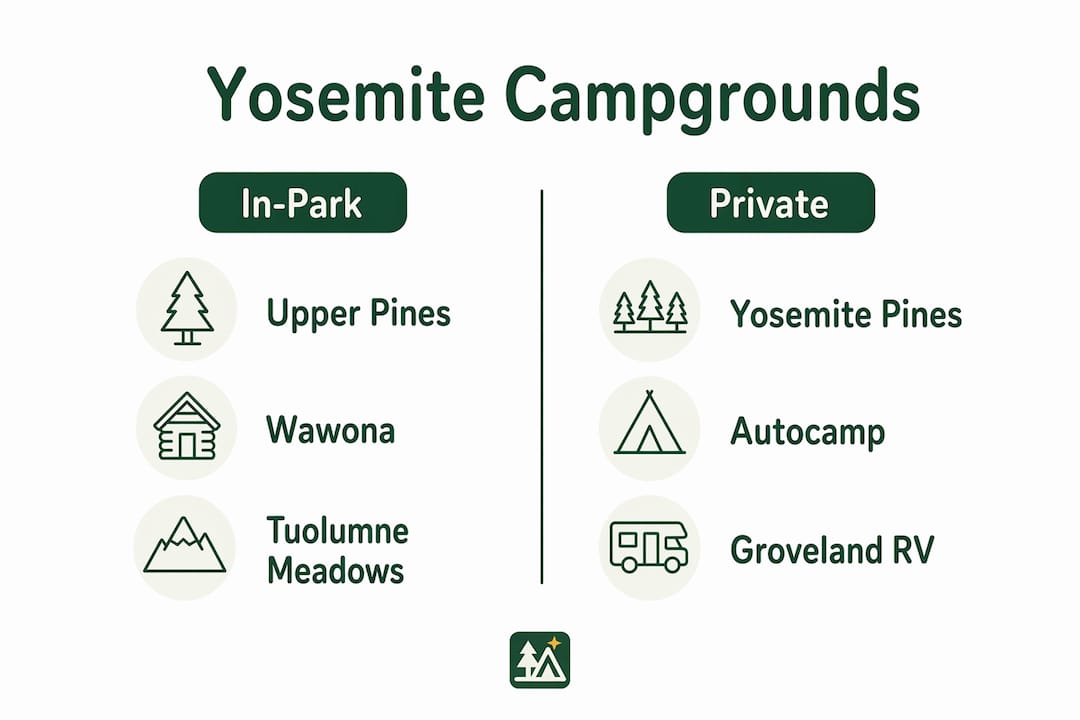
Upper Pines, Lower Pines, and North Pines are the strongest picks for families who want to wake up inside Yosemite Valley. Upper Pines is the only Valley campground open year-round, with 236 sites and a dump station. Lower Pines (74 sites, seasonal) and North Pines (81 sites, seasonal) round out the Valley cluster with river-front settings and easy trail access. For high-country solitude and cooler nights, Tuolumne Meadows is the standout. Families who need full hookups or can't land an in-park reservation have two solid private alternatives: Yosemite Pines RV Resort and Autocamp Yosemite, both near Groveland. Camp 4 is the pick for climbers and budget tent campers willing to work a different booking system.
| Campground | Best For | RV Hookups | Reservation Difficulty | Season |
|---|---|---|---|---|
| Campgazer | Families and RVers needing live alerts | N/A (search tool) | Simplifies booking | Year-round |
| Upper Pines | Families, Valley access | Dump station only | Very high | Year-round |
| Lower Pines | Scenic river sites | No hookups | Very high | April–October |
| North Pines | Families, tent campers | No hookups | Very high | April–October |
| Camp 4 | Climbers, budget campers | No hookups | Moderate (lottery) | April–November |
| Tuolumne Meadows | High-country, backpackers | Dump station nearby | High | July–September |
| Wawona | Families, sequoia access | No hookups | Moderate | Year-round |
| Yosemite Pines RV Resort | RVers needing hookups | Full hookups | Low | Year-round |
| Autocamp Yosemite | Comfort-forward families | Glamping amenities | Moderate | Seasonal |
- Valley cluster (Upper, Lower, North Pines): closest to Half Dome, Yosemite Falls, and Valley shuttle stops; sell out within minutes of release
- High-country (Tuolumne Meadows, White Wolf, Yosemite Creek): cooler temps, fewer crowds, longer drives to Valley landmarks
- Private alternatives (Yosemite Pines RV Resort, Autocamp Yosemite): full hookups or glamping amenities, higher availability, near Big Oak Flat entrance
Table of Contents
- What are the best campgrounds near Yosemite, compared side by side?
- How do you pick the right campground for your group and rig?
- How do you actually secure a Yosemite campsite before it sells out?
- What private campgrounds near Yosemite offer hookups and showers?
- Why high-country campgrounds often beat the Valley in summer
- Key Takeaways
- The monitoring-first approach is the one most campers skip
- Campgazer helps you find and monitor Yosemite campsites without the scramble
- Useful sources for Yosemite campground planning
What are the best campgrounds near Yosemite, compared side by side?
The twelve in-park campgrounds split cleanly into three clusters: the Valley floor, the southern corridor near Wawona, and the high country along Tioga Road. Each cluster trades something for something else.
Valley floor: Upper Pines, Lower Pines, and North Pines
These three campgrounds sit within walking distance of Yosemite Valley's most iconic sights. Upper Pines is the largest and the only one open all year. Its dump station serves RVers who dry-camp, and the location puts you minutes from the Valley shuttle. No electrical hookups exist anywhere in the park, so RVers here are running on generator or solar. Lower Pines hugs the Merced River with 74 sites and a more intimate feel; it opens in April and closes in October. North Pines offers 81 sites with river-front options and slightly less foot traffic than Upper Pines, also running April through October.
All three sell out within minutes when reservations open, which is the single biggest planning challenge for the Valley.
Camp 4
Camp 4 is a different animal. It's walk-in, tent-only, and built around climbers' culture. The fee is $10 per person per night, not per site, which makes it one of the cheapest nights in the park. During peak season (roughly April 15 through November 9), reservations open on a rolling seven-day window. Off-season it reverts to first-come, first-served. If you're not a climber, the communal, social vibe is still appealing, but the tent-only rule is firm.
Wawona Campground
Wawona sits about 27 miles south of the Valley, near the Mariposa Grove of Giant Sequoias. With roughly 95 sites, it's open year-round, though reservations are required from approximately April through October. A dump station is nearby. Families who want to spend a morning walking among giant sequoias and an afternoon at the historic Pioneer Yosemite History Center will find Wawona a primary destination, not a consolation pick.
Bridalveil Creek Campground
Bridalveil Creek sits south of the Valley off Glacier Point Road, surrounded by forest. It offers flush toilets, putting it a step above the most rustic options. Open roughly July through early September, it's a quieter alternative to the Valley floor with reasonable proximity to Glacier Point and Sentinel Dome.
Hodgdon Meadow Campground
Hodgdon Meadow is near the Big Oak Flat (Highway 120) entrance, making it the most practical base for travelers arriving from the Bay Area or Central Valley. It's open year-round, with reservations required April through October. Sites accommodate RVs, though there are no hookups. In winter it runs first-come, first-served.
Crane Flat Campground
Crane Flat sits 17 miles from Yosemite Valley at 6,200 feet elevation. Roads and parking spurs are paved, flush toilets and drinking water are provided, and a gas station and small general store are nearby. It's positioned between the Tuolumne and Merced Groves of Giant Sequoias, both accessible by a 2.5–3-mile round-trip hike. Open July through early October.
Tamarack Flat Campground
Tamarack Flat is tent-only and reached by a rough, unpaved side road off Tioga Road. Water from the creek requires treatment before drinking. It's the right choice for tent campers who want a genuinely rustic experience without driving far into the backcountry. Open July through early October.
White Wolf Campground
White Wolf sits at high elevation between Crane Flat and Tuolumne Meadows, open July through early September. The nearby White Wolf Lodge operates seasonally and offers a small dining room and basic supplies, which gives families a bit of a safety net. It's a good middle ground between the full amenities of the Valley and the austerity of the most remote Tioga Road sites.
Yosemite Creek Campground
Yosemite Creek is reached by a bumpy, unpaved side road and has no on-site potable water. It's the quietest option on Tioga Road, genuinely off the beaten path. Open July through early September. Bring all the water you need, or plan to treat creek water.
Tuolumne Meadows Campground
Tuolumne Meadows is the park's largest high-country campground, with 289–315 sites depending on the season's configuration. Half the sites open on the standard five-month-ahead reservation window; the other half release on a rolling 14-day window. A dump station operates seasonally nearby. Open approximately July through late September, it's the hub for Tioga Road hiking and a cooler, quieter alternative to the Valley in peak summer.
Private alternatives: Yosemite Pines RV Resort and Autocamp Yosemite
Yosemite Pines RV Resort, near Groveland, is the clearest answer for RVers who need full hookups. Hot showers, electricity, and family-oriented services are all on-site. It's outside the park near the Big Oak Flat entrance, so Valley access requires a drive, but availability is far more predictable than any in-park site.
Autocamp Yosemite, also near Groveland, takes a different approach: canvas tents and Airstream trailers with concierge-style services. It's not a traditional RV park, but it fills the gap for families who want comfort-forward camping without hauling a rig. Drive time to the Valley is longer than from the Valley floor campgrounds, but the booking experience is considerably less stressful.
Comparison table: in-park campgrounds and private alternatives
| Campground | Open Dates | Sites | RV Fit | Key Amenities | Proximity to Valley | Reservation Difficulty | Crowding |
|---|---|---|---|---|---|---|---|
| Upper Pines | Year-round | 236 | Yes (dump station) | Flush toilets, potable water, bear boxes | Walking distance | Very high | High |
| Lower Pines | April–October | 74 | Yes (no hookups) | Flush toilets, potable water, bear boxes | Walking distance | Very high | High |
| North Pines | April–October | 81 | Yes (no hookups) | Flush toilets, potable water, bear boxes | Walking distance | Very high | High |
| Camp 4 | April–November | No hard site count given | No (tent only) | Flush toilets, potable water, bear boxes | Walking distance | Moderate (lottery) | Social/communal |
| Tuolumne Meadows | July–September | 289–315 | Yes (dump station nearby) | Flush toilets, potable water, bear boxes | ~1.5 hr drive | High | Moderate |
| Wawona | Year-round | ~95 | Yes (dump station nearby) | Flush toilets, potable water, bear boxes | ~45 min drive | Moderate | Moderate |
| Bridalveil Creek | July–early September | 289–315 | Limited | Flush toilets, potable water, bear boxes | ~45 min drive | Moderate | Low |
| Hodgdon Meadow | Year-round | — | Yes (no hookups) | Flush toilets, potable water, bear boxes | ~45 min drive | Moderate | Low–Moderate |
| Crane Flat | July–early October | — | Yes (no hookups) | Flush toilets, potable water, bear boxes | ~30 min drive | Moderate | Low–Moderate |
| White Wolf | July–early September | ~74 | Limited | Flush toilets, potable water, bear boxes | ~1 hr drive | Low–Moderate | Low |
| Tamarack Flat | July–early October | 74 | No (tent only) | Vault toilets, no potable water | ~1 hr drive | Low | Very low |
| Yosemite Creek | July–early September | 81 | No (rough road) | Vault toilets, no potable water | ~1 hr drive | Low | Very low |
| Yosemite Pines RV Resort | Year-round | Varies | Full hookups | Showers, electricity, store | ~1 hr drive | Low | Low |
| Autocamp Yosemite | Seasonal | Limited | Glamping (Airstreams) | Showers, concierge services | ~1 hr drive | Moderate | Low |
Valley vs. high-country vs. private: quick trade-offs
- Valley (Upper/Lower/North Pines): best location, hardest to book, highest crowds, no hookups
- High-country (Tuolumne Meadows, White Wolf, Yosemite Creek, Tamarack Flat): cooler nights, far fewer crowds, longer drive to Valley landmarks, seasonal access only
- Private (Yosemite Pines RV Resort, Autocamp Yosemite): full hookups or glamping amenities, easiest to book, farthest from Valley floor
How do you pick the right campground for your group and rig?
The fastest way to narrow your options is to answer four questions: Do you need hookups? How close do you want to be to the Valley? How much crowd noise can you tolerate? And what's your rig length?
If you need electrical or water hookups, skip every in-park option. No campsite inside Yosemite has electrical, water, or sewer hookups. Head straight to Yosemite Pines RV Resort or check private parks near the Big Oak Flat entrance. If you're dry camping in an RV, Upper Pines and Hodgdon Meadow are the most RV-accommodating in-park options, with paved spurs and dump station access. For practical tips on managing waste during dry camping, RV dry camping waste management is worth a read before you go.
If Valley proximity is your top priority, Upper Pines, Lower Pines, and North Pines are the only real answers. You'll be within walking distance of shuttle stops, trailheads, and the Valley Visitor Center. The trade-off is that these sites sell out almost instantly, and the Valley floor gets loud and crowded in summer.
If your family wants cooler nights and fewer neighbors, the Tioga Road campgrounds are often the better choice. Tuolumne Meadows, White Wolf, and Bridalveil Creek all offer significantly lower crowding than the Valley. Travel writers at Condé Nast Traveler recommend high-country campgrounds not as a backup but as a genuinely superior summer experience for families who want a quieter, more wilderness-focused trip.
For families focused on giant sequoias, Wawona is the right base. It's close to the Mariposa Grove, has year-round access, and offers a more relaxed pace than the Valley.
Decision checklist before you book:
- Rig length and whether you need hookups (determines in-park vs. private)
- Party size and whether you need multiple adjacent sites
- Preferred proximity to Valley landmarks (Half Dome, Yosemite Falls)
- Tolerance for crowds and noise
- Elevation sensitivity (Tuolumne Meadows sits above 8,600 feet; altitude affects sleep and vehicle performance)
- Desired amenities: flush toilets, hot showers, potable water on-site
Pro Tip: Elevation matters more than most campers expect. Tuolumne Meadows sits above 8,600 feet, where nighttime temps can drop below freezing even in July. Pack layers regardless of the forecast, and if anyone in your group has altitude sensitivity, spend a night at a lower-elevation site first before heading up Tioga Road.
How do you actually secure a Yosemite campsite before it sells out?
Knowing the booking rules is half the battle. Most Yosemite campgrounds operate on a five-month advance reservation window: reservations open on the 15th of each month at 7:00 AM Pacific time, exactly five months before the arrival date. Sites for a July 15 arrival, for example, open on February 15. Many sell out within minutes of that window opening.
Tuolumne Meadows works differently. Half its sites follow the standard five-month window; the other half release on a rolling 14-day window. Camp 4 releases on a seven-day rolling window during peak season (April 15 through November 9) and reverts to first-come, first-served in the off-season.
Step-by-step booking strategy:
- Set your target date and count back five months. Mark the 15th of that month in your calendar with a 6:45 AM alarm. Log into Recreation.gov before 7:00 AM PT and have your party size, rig length, and preferred campground pre-selected.
- Set up live availability alerts on Campgazer. If you miss the initial release or your preferred dates are gone, Campgazer's live cancellation monitoring watches for openings across both public and private listings and alerts you when a site becomes available.
- Target cancellations strategically. Cancellations happen most often 2–3 days before arrival (when people finalize plans) and around the 30-day mark (when the cancellation fee structure changes). Checking at these windows manually, or letting Campgazer alerts run continuously, gives you the best shot at a Valley site.
- Prepare a backup plan before you need it. If Valley sites are gone, have Tuolumne Meadows or Hodgdon Meadow already queued as alternatives. Private parks near Groveland are your fallback for hookups.
- For Camp 4, check Recreation.gov seven days before your target arrival date at 7:00 AM PT. If that window is full, arrive early in person for first-come spots in the off-season.
Example timeline for a summer trip (July 4 arrival):
- February 15: Reservation window opens at 7:00 AM PT for July 15 arrivals. Set alert for July 4 arrivals, which opened January 15.
- Ongoing: Campgazer alerts monitor cancellations for Upper Pines, Lower Pines, and North Pines.
- June 20 (14 days out): Check Tuolumne Meadows rolling-window releases.
- June 27 (7 days out): Check Camp 4 rolling-window releases.
- Fallback: If nothing opens, book Yosemite Pines RV Resort or Autocamp Yosemite directly.
Pro Tip: You can make only two reservations per website visit on Recreation.gov. If you want to hold multiple sites or dates simultaneously, you'll need to start a new session. Keep your credit card and login ready, and use a device with a fast, reliable connection. A slow mobile connection at 6:59 AM has cost more than a few campers their Valley site.
What private campgrounds near Yosemite offer hookups and showers?
When in-park sites are gone or your rig needs electricity and water, two private options near the Big Oak Flat entrance stand out.
Yosemite Pines RV Resort is the most practical choice for RVers who need full hookups. Hot showers, electricity, and family-oriented services are all on-site. It sits near Groveland, close to the Highway 120 corridor, which means the Big Oak Flat entrance is your gateway into the park. Availability is far more predictable than any in-park site, and the resort caters specifically to families and larger rigs. If you're comparing private park amenity layouts, Campgazer's private park listings show the kind of site-level detail (hookup types, pull-through lengths, amenity ratings) that helps you confirm a park fits your rig before you commit.
Autocamp Yosemite takes a different approach. Canvas tents and Airstream trailers replace traditional RV sites, and the experience leans toward comfort-forward glamping with concierge-style services. It's not the right fit if you're hauling your own rig, but for families who want a memorable stay without the booking scramble of the Valley, it fills a real gap.
| Private Option | Full Hookups | Hot Showers | Family Activities | Drive to Valley | Best Entrance |
|---|---|---|---|---|---|
| Yosemite Pines RV Resort | Yes | Yes | Yes | ~1 hour | Big Oak Flat (Hwy 120) |
| Autocamp Yosemite | Glamping amenities | Yes | Yes | ~1 hour | Big Oak Flat (Hwy 120) |
When to choose a private park over an in-park site:
- Your rig requires electrical or water hookups
- You're booking last-minute and in-park sites are sold out
- You need accessible amenities (paved sites, on-site showers, store)
- You're traveling with a large group that needs adjacent sites
- You want a more predictable, lower-stress arrival experience
Both options serve the Big Oak Flat entrance best. If you're entering from the south (Wawona/South Entrance), look for private options along Highway 41 near Fish Camp instead.
Why high-country campgrounds often beat the Valley in summer
The case for Tioga Road campgrounds isn't just "go there if the Valley is full." Travel writers and experienced Yosemite campers increasingly treat high-country campgrounds as the superior summer choice for families who want cooler temperatures, fewer crowds, and a more genuine wilderness feel.
The elevation difference is significant. Yosemite Valley sits at roughly 4,000 feet. Tuolumne Meadows is above 8,600 feet, White Wolf above 8,000 feet, and Yosemite Creek above 7,600 feet. That elevation gap translates to noticeably cooler nights and, in most summers, far less wildfire smoke than the Valley floor collects. It also means a shorter season: most Tioga Road campgrounds don't open until July, and some close by early September.
| Campground | Elevation | Typical Open Dates | Sites | Potable Water |
|---|---|---|---|---|
| Tuolumne Meadows | ~8,600 ft | July–late September | 289–315 | Yes |
| White Wolf | ~8,000 ft | July–early September | ~74 | Yes |
| Yosemite Creek | 8,600 ft | July–early September | 81 | No (treat creek water) |
| Tamarack Flat | 6,200 feet | July–early October | 74 | No (treat creek water) |
| Crane Flat | 6,200 ft | July–early October | — | Yes |
The practical trade-off is drive time. Tuolumne Meadows is roughly 1.5 hours from the Valley floor via Tioga Road, which closes in winter and can stay closed into June in heavy snow years. If your itinerary centers on Valley landmarks like Half Dome or Yosemite Falls, you're looking at a full morning's commitment for a day trip. For families whose priority is hiking, stargazing, and cool nights rather than standing at the base of a waterfall, that trade-off is worth it.
Pro Tip: High-country campgrounds are also a smart choice for smoke avoidance. In late summer, Valley inversions trap wildfire smoke at lower elevations while sites above 7,000 feet often sit above the haze. Check air quality forecasts for both elevation bands before you finalize your site.
Key Takeaways
Upper Pines is the only year-round Valley campground, reservations open five months ahead on the 15th at 7:00 AM PT, and no in-park site offers electrical hookups, making private parks the only option for RVers who need them.
| Point | Details |
|---|---|
| Valley campgrounds sell fast | Upper Pines (236 sites), Lower Pines (74), and North Pines (81) sell out within minutes of the 7:00 AM PT release. |
| No in-park hookups | Every in-park campground is hookup-free; RVers needing electricity must book Yosemite Pines RV Resort or similar private parks. |
| Book on the 15th, five months out | Set a 6:45 AM PT alarm on the 15th of the month, five months before your arrival, and log into Recreation.gov before the window opens. |
| High-country is a real alternative | Tioga Road campgrounds (Tuolumne Meadows, White Wolf, Yosemite Creek) offer cooler temps and far fewer crowds, open July through September. |
| Campgazer monitors cancellations | Use Campgazer's live alerts and rig-size filters to catch Valley cancellations and compare private park options when in-park sites are gone. |
The monitoring-first approach is the one most campers skip
Most Yosemite trip-planning advice focuses on the 15th-of-the-month release window. That's correct, but it's only half the strategy. The other half is what happens after that window closes with your dates still unavailable.
Cancellations for Valley campgrounds happen constantly, right up to the day before arrival. The campers who land those sites aren't refreshing Recreation.gov manually at random hours. They're using tools that watch inventory continuously and send an alert the moment a site opens. That's exactly what Campgazer's live cancellation monitoring does, and it's the part of the booking process that most guides gloss over.
Rig-specific filters matter too. A 40-foot fifth wheel and a 20-foot travel trailer don't have the same site options, and booking a site that can't physically accommodate your rig wastes everyone's time. Campgazer's database covers 10,000+ campgrounds with site-level specs, so you can filter by rig length before you commit to a reservation.
The combination of real-time alerts and rig-specific search is what closes the gap between "I couldn't get a site" and "I got exactly the site I wanted."
Campgazer helps you find and monitor Yosemite campsites without the scramble
Yosemite's best campgrounds fill within minutes of release, and the Valley sites you want most are the hardest to get. Campgazer gives you a real edge: live cancellation alerts that notify you the moment a site opens, rig-size filters that match your vehicle to compatible sites, and a unified search across public and private listings so you're not bouncing between Recreation.gov and a dozen private park websites.
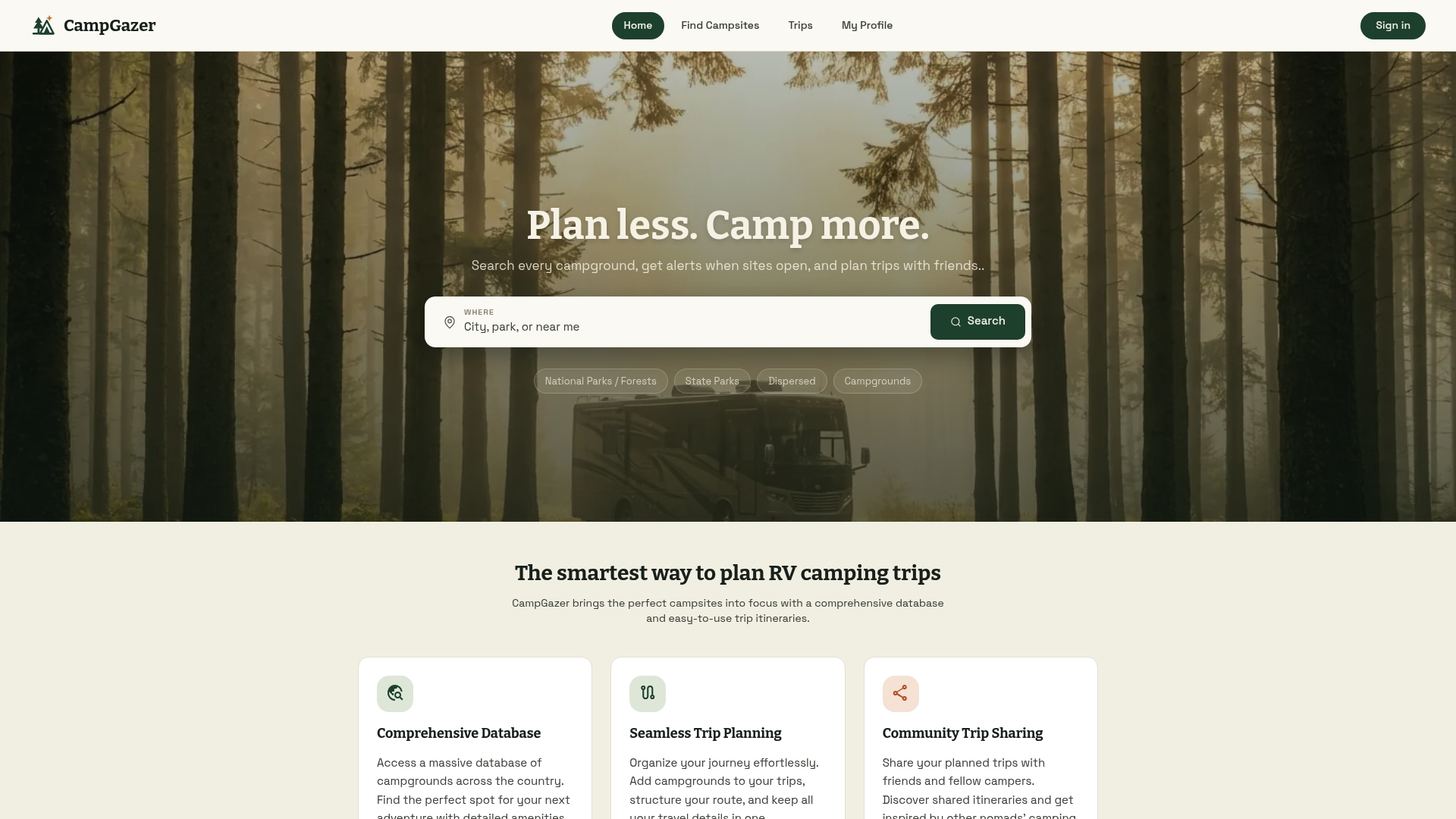
Here's how to use Campgazer for a Yosemite trip in three steps. First, search by location and rig specs to build a shortlist of in-park and private options that actually fit your setup. Second, set live alerts for your preferred campgrounds and dates so you catch cancellations automatically. Third, book directly through Recreation.gov or the private park's booking page using the links Campgazer surfaces. The platform covers 10,000+ campgrounds with detailed amenity data, community photos, and trip itinerary tools built for families and RVers. Start your Yosemite trip plan on Campgazer and set your first alert before the next 15th rolls around.
Useful sources for Yosemite campground planning
- NPS Yosemite campgrounds page: Official source for open dates, site counts, reservation rules, and dump station locations. The single most authoritative reference for in-park camping.
- NPS Camp 4 page: Specific rules for Camp 4's walk-in, tent-only system, lottery/reservation windows, and the $10 per-person fee.
- Recreation.gov Yosemite camping search: Live inventory and the official booking portal for all developed Yosemite campgrounds, including Upper Pines, Lower Pines, North Pines, and Wawona.
- Recreation.gov Wawona Campground page: Direct booking and site details for Wawona, including loop maps and seasonal availability.
- Condé Nast Traveler Yosemite camping guide: Expert travel writing on when to go, which campgrounds to prioritize, and why high-country sites deserve more credit.
- Campgazer: Live availability alerts, rig-size filters, and unified campsite search across public and private listings for Yosemite and 10,000+ campgrounds nationwide.