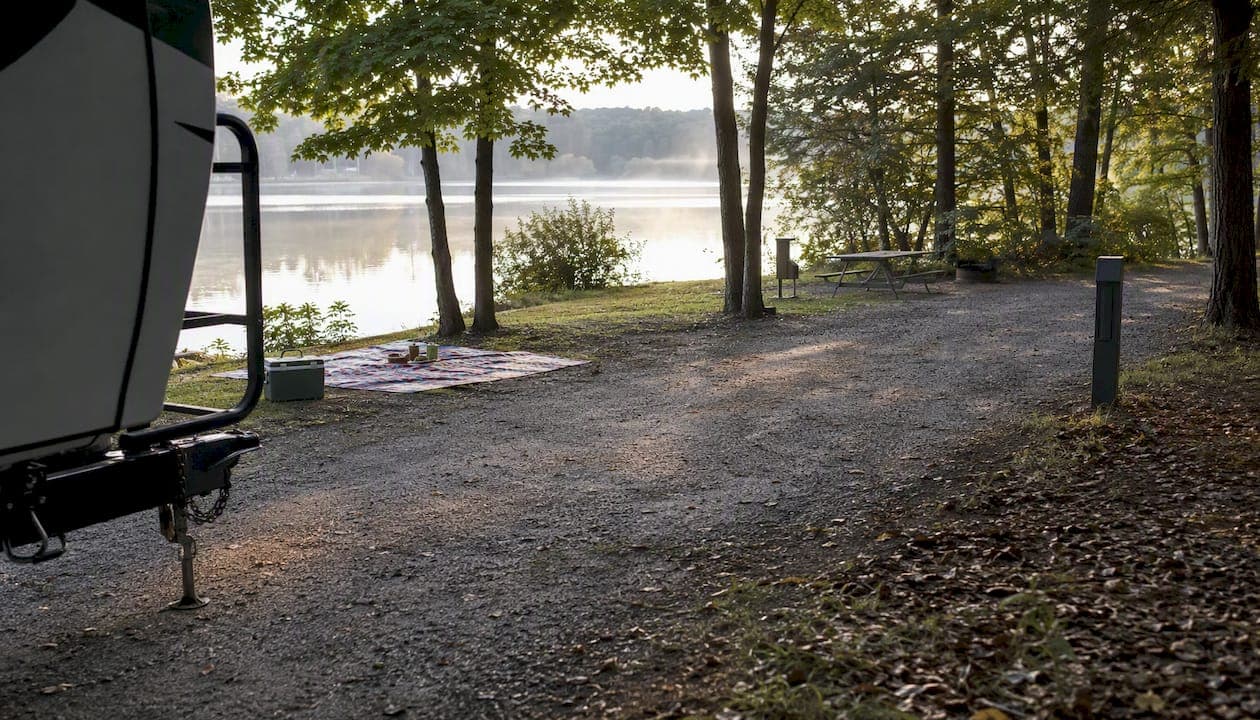
A pull-through campsite is a site you drive into from one end and exit from the other without ever backing up. Choose one when your rig runs long, when you're towing a vehicle behind your motorhome, or when you simply want to arrive and leave without the stress of reversing in the dark. KOA campgrounds and state park systems across the country list pull-through sites specifically for rigs that need the extra room, and platforms like Campgazer let you filter for them before you ever leave your driveway.
Table of Contents
- What exactly is a pull-through campsite?
- Pull-through vs. back-in: which site type fits your trip?
- How to measure your rig to confirm it fits a pull-through pad
- How to find and book pull-through campsites
- Campgazer makes finding pull-through sites faster
- Key takeaways
- The view from here
- Useful sources and further reading
What exactly is a pull-through campsite?
The terms pull-through, pull-thru, and drive-through all describe the same layout: a site with a clear entry point at one end and an exit at the other, so your rig travels in a straight line in and out. No spotter needed. No 14-point reverse maneuver.
Most campgrounds offer three variations.
Single pull-through sites are the standard: one pad, one vehicle, one direction of travel. The pad runs parallel to the road or loops around a gentle curve, and you simply follow it through. Pecan Creek RV Park in Hillsboro, TX, for example, advertises pull-thru pads wide enough for slide-outs and long enough to fit rigs up to 80 feet.
Buddy or side-by-side pull-throughs place two pads next to each other, sharing a common entry and exit lane. Groups and families traveling together often book these so their rigs sit adjacent without the awkward gap of a standard site between them.
Deluxe or extended pull-throughs are the premium tier. Buckeye Ranch RV Resort labels its longer pads "deluxe" at 75 feet versus a standard 60-foot pad, often adding picnic tables, pet areas, or closer proximity to bathhouses.
When you're scanning campground listings, watch for these labels:
- Pull-through, pull-thru, PT
- Drive-through, drive-thru
- Big-rig friendly, extra-long, extended pad
- Deluxe pull-through, premium pull-through
- Buddy pull-through, side-by-side
Pull-through vs. back-in: which site type fits your trip?
The honest answer is that neither site type is universally better. The right choice depends on your rig, your skill level, and what you want from the stay.
| Dimension | Pull-through | Back-in |
|---|---|---|
| Short rigs | Works fine; may feel oversized | Fits easily; more options available |
| Long rigs (40–80 ft) | Ideal; designed for big rigs | Difficult or impossible to maneuver |
| First-time drivers | Low stress; no backing required | Steep learning curve without a spotter |
| Privacy | Lower; sites face the road on both ends | Higher; rear of rig faces away from traffic |
| Availability | Fewer per campground; books fast | More abundant at most parks |
| Cost | Often $5–$10 more per night | Usually the base rate |
| Full hookups | Frequently included | Common at all levels |
| Pad surface/levelness | Varies; gravel or concrete, often well-graded | Varies; may require more leveling blocks |
Pull-through sites trade a bit of privacy for a lot of convenience. Your awning and door typically face the road, which means more foot traffic in view. Back-in sites flip that equation: your living space opens toward a tree line or a quieter corner of the campground, but you earn that privacy by reversing a 40-foot trailer into a narrow slot.
For overnight stops on a long route, pull-throughs win on pure efficiency. For a week-long stay where you want to feel settled and secluded, a back-in site often delivers a better experience.
How to measure your rig to confirm it fits a pull-through pad
1000 Islands Campground publishes pad lengths of 77 and 88 feet for its pull-through full-hookup sites, with 20/30/50-amp service listed per pad. That level of detail is what you want to see before booking. Here's how to match your rig to a listed pad length:
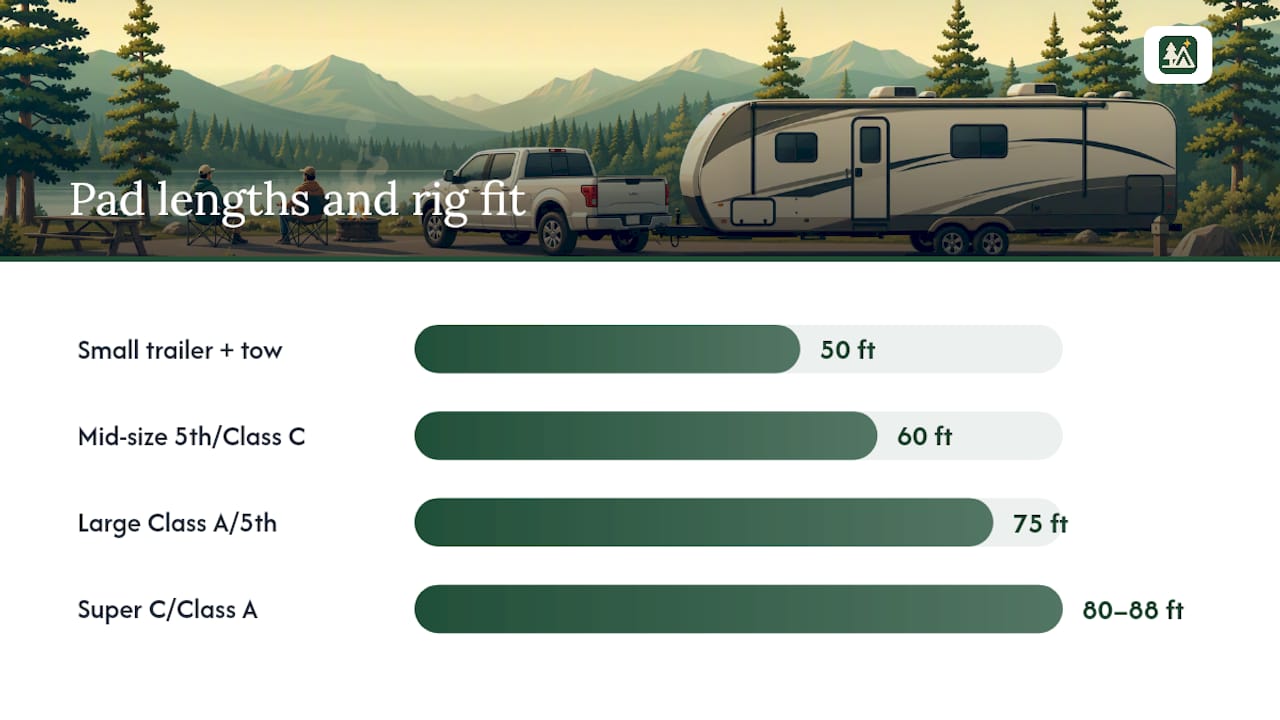
| Pad length | Typical rig fit |
|---|---|
| 50 ft | Small travel trailer with tow vehicle |
| 60 ft | Mid-size fifth wheel or Class C motorhome (30–35 ft) |
| 75 ft | Large Class A motorhome (40–45 ft) or fifth wheel with truck |
| 80–88 ft | Super C or Class A (45 ft) with towed vehicle or extended trailer |
Step-by-step measuring process:
- Measure your motorhome or trailer from the front hitch receiver (or bumper) to the rear bumper.
- If towing a dinghy or tow vehicle, add that length plus the tow bar or dolly (typically 4–6 feet).
- Add 5 feet of buffer on each end for safe maneuvering and hookup access.
- Compare that total to the listed pad length. If the pad is shorter than your total, contact the campground directly.
- Check pad width. Most pull-throughs run 20–30 feet wide, but if you have dual slide-outs, confirm there's clearance on both sides before your neighbors set up.
Pad surface matters too. Concrete pads stay level and drain cleanly; gravel pads can shift and may require leveling blocks even on a well-graded site. Windmill RV Ranch in Bertram, TX, lists its pull-through pads with full hookups and describes them as suited for larger RVs and full-time RVers, a signal that the surface and spacing are built for serious rigs.
How to find and book pull-through campsites
The fastest search workflow starts with a platform that already has site-type filters built in. Campgazer indexes more than 10,000 campgrounds with amenity-level detail, so you can filter by site type, pad length, and hookup type without opening a dozen individual campground pages. From there, the map view lets you check the approach road and confirm there are no sharp turns or low bridges between the highway and your site.
Once you've shortlisted a few options, verify directly with the campground:
- Confirm the pad length matches your rig's total length plus buffer.
- Ask which side the electrical pedestal is on (driver's or passenger's side).
- Check for height restrictions at the entrance gate.
- Ask about the pad surface and whether leveling blocks are typically needed.
- Have a backup site in mind in case your first choice is already booked.
Timing matters. For peak summer and fall travel, Pigeon Forge RV Resort and similar resort operators recommend reserving 60–90 days in advance. State parks like those managed by the Georgia Department of Natural Resources publish overnighting policies and reservation windows on their sites, and those windows fill faster than most campers expect.
Pro Tip: Use Campgazer's map view to trace your approach route before you arrive. A satellite view of the campground entrance often reveals tight turns or low-hanging tree canopies that the listing description won't mention. Checking it at home takes two minutes; discovering it in a 45-foot Class A takes considerably longer.
For a real-world example of how site specs appear in a listing, the Pigeon Forge / Gatlinburg KOA Holiday page on Campgazer shows site types, hookup options, and pad details in one place. KOA campgrounds across the country consistently label their pull-through sites with pad lengths and amp ratings, making them a reliable reference point when you're learning what to look for. You can also browse national park gear and guides if you're pairing a campground stay with a national park visit nearby.
Campgazer makes finding pull-through sites faster
Scanning individual campground websites to verify pad lengths, hookup types, and site availability takes time you could spend on the road. Campgazer puts more than 10,000 campgrounds in one searchable database, with site-type filters, pad-length specs, amenity flags, and a map-based approach view that shows you the access road before you commit.
The itinerary builder lets you sequence multiple stops, match each campground to your rig's specs, and share the plan with travel partners. Whether you're looking for a KOA pull-through site with concrete pads and 50-amp service or a quieter state park pad for a mid-week overnight, the filters surface the right options without the tab-switching. Start your search at Campgazer and find your next pull-through site in minutes.
Key takeaways
Pull-through campsites are the practical choice for long rigs, towed vehicles, and low-stress arrivals — but confirming pad length, hookup side, and surface type before you book prevents the most common surprises.
| Point | Details |
|---|---|
| Measure before you book | Total rig length plus 5-foot buffers on each end must fit within the listed pad length. |
| Pad lengths vary widely | Common pull-through pads range from 60 feet for standard sites to 75 feet for deluxe pads, and some campgrounds list pull-throughs up to 80 or 88 feet; confirm the exact figure with the campground. |
| Full hookups are common | Most dedicated pull-through sites include water, sewer, and 30/50-amp electric service. |
| Book early for peak seasons | Resort operators recommend reserving pull-through sites 60–90 days ahead for summer and fall. |
| Use Campgazer to search | Campgazer's site-type filters and pad-length specs cover 10,000+ campgrounds in one search. |
The view from here
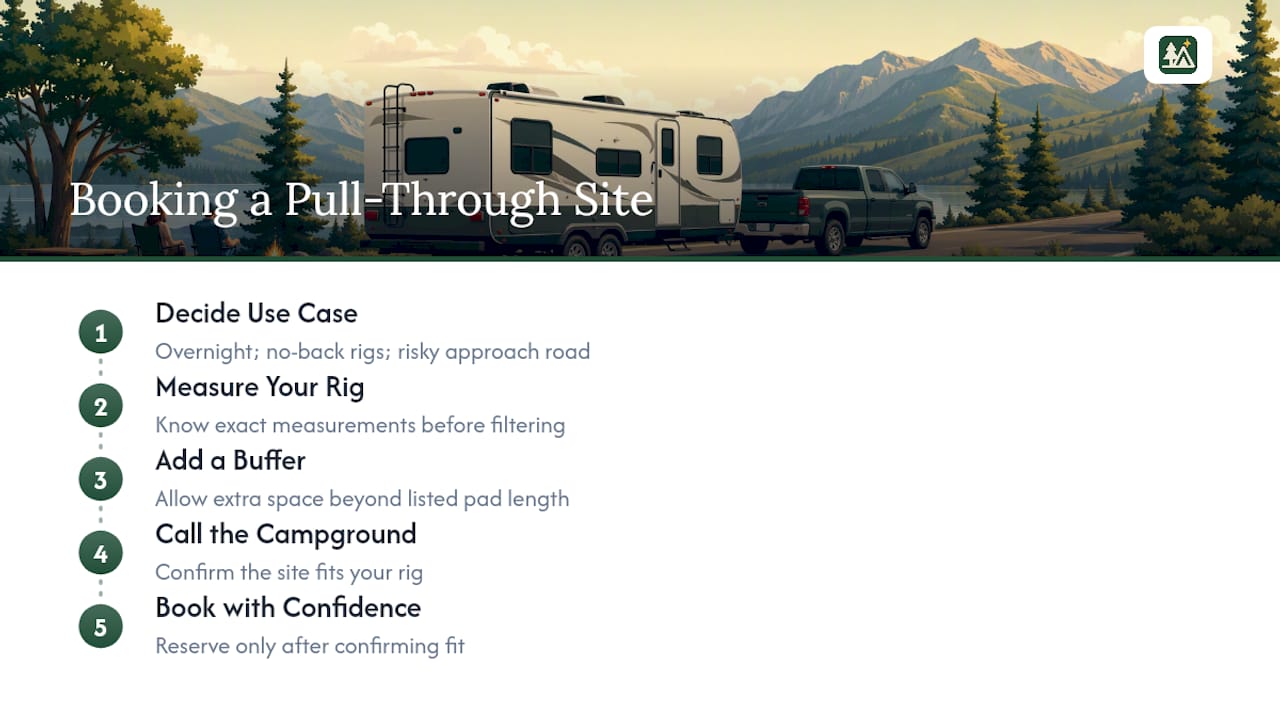
There's a tendency in RV planning content to treat pull-through sites as the obvious, universal answer for anyone with a big rig. The reality is more nuanced. A pull-through gives you frictionless arrival, but it also places your living space facing the road, which changes the feel of a multi-night stay in ways that matter. The campers who get the most out of pull-throughs are the ones who use them intentionally: for overnight stops, for rigs that genuinely can't back in safely, and for campgrounds where the approach road makes a back-in site genuinely risky.
What gets underestimated is the value of knowing your rig's exact measurements before you ever open a search filter. Pad length listings are only useful if you know what number to compare them against. The campers who arrive stressed are usually the ones who assumed a "big-rig friendly" label was enough. It isn't. Measure the rig, add the buffer, call the campground, and then book with confidence.
Useful sources and further reading
A short list of authoritative pages worth bookmarking when you're researching pull-through sites and campground specs:
- Camping in Georgia State Parks
- Pull-Thru RV Sites in Hillsboro, TX | Pecan Creek RV Park
- Pull-Through RV Sites - Windmill RV Ranch | Bertram, TX
- Pull Through
- Pull-Through RV Sites Pigeon Forge | Big Rig Friendly | PFRV | Pigeon Forge RV Resort
- RV Sites | Buckeye Ranch RV Resort
- georgia.gov
- Overnighting - GADNR
Always verify pad length, hookup configuration, and surface type directly with the campground before you finalize a reservation. Listings are a starting point, not a guarantee.