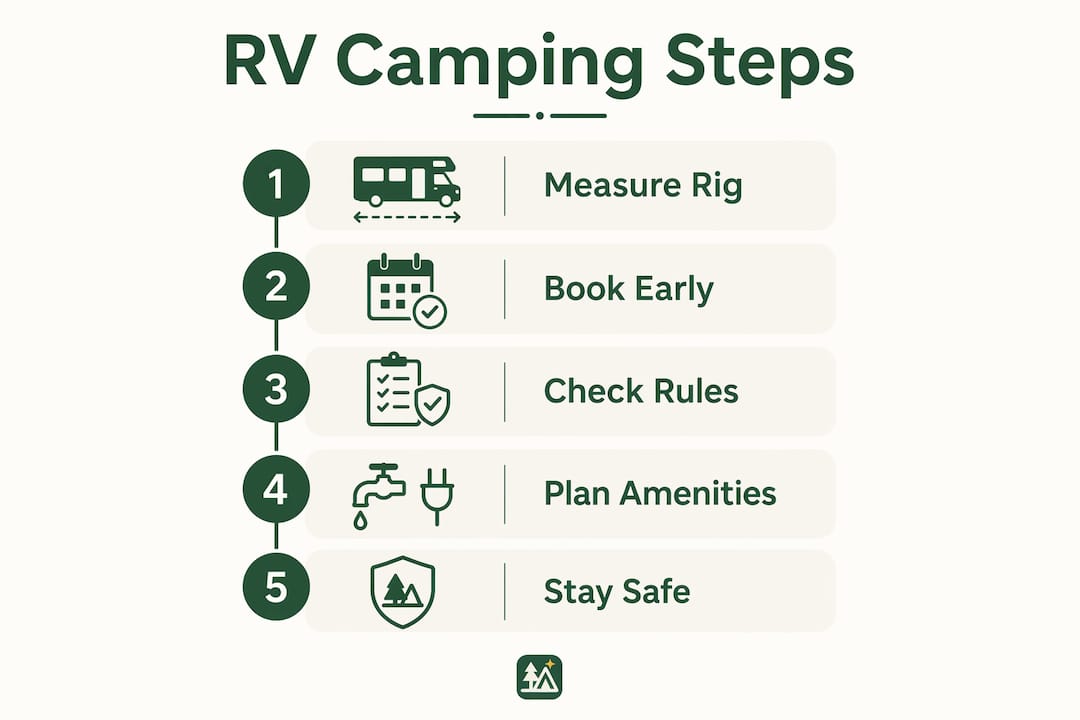
Yes, you can RV camp in most U.S. national parks — but site availability and rig restrictions vary enough that checking before you book is non-negotiable. Here's your immediate action list:
- Check the park's NPS campground page under "Plan Your Visit" for site rules, max vehicle lengths, and road restrictions.
- Search Recreation.gov for live availability, site photos, and posted length limits by loop.
- Run a Campgazer search at campgazer.com to filter by rig length, hookup type, and nearby private alternatives.
- Verify four things before booking: your rig's bumper-to-bumper length, the booking window open date, generator policy, and whether the site has hookups or requires dry camping.
That four-point check takes under a minute and prevents the most common RV trip surprises.
Table of Contents
- Where do you find official campsite info and reservations?
- How national park reservations work and the timing tactics that win sites
- RV-specific park rules and rig constraints to verify before you go
- What campground layouts and amenities should RVers expect?
- What does RV camping in national parks actually cost?
- Practical RV management tips for national park stays
- Which national parks are most RV-friendly?
- How to get into a sold-out campground
- Campfire and charcoal grill rules in national parks
- Finding dump stations inside and near national parks
- When is the best time to visit national parks in your RV?
- Key Takeaways
- The tradeoff most RV campers learn the hard way
- Plan your national park RV trip faster with Campgazer
- Useful sources for live campground details
Where do you find official campsite info and reservations?
Three sources do most of the work, and each has a distinct role.
NPS park pages are the authoritative starting point. Go to the park's website, click "Plan Your Visit," then look under "Eating & Sleeping." You'll find campground maps, site rules, vehicle-size restrictions, and seasonal closure notices specific to that park. No other source overrides what's posted here.
Recreation.gov is the reservation engine for most national park campgrounds. Beyond booking, it shows max vehicle length per site, loop photos, and amenity details. Use the "Filter" options to narrow by RV length before you even look at availability calendars. This saves you from booking a site your rig can't physically fit.
The NPS app (available on the App Store and Google Play) is worth downloading for any trip. Under the "Where to Stay" menu, you'll find park-specific camping info, and you can download park data for offline use when cell service is spotty inside park boundaries.
When inside-park sites are sold out or require dry camping you're not equipped for, private campgrounds and KOA locations near park entrances often offer full hookups with easier reservations. State parks and BLM land nearby can also serve as practical overflow options. Always cross-reference generator hours, bear storage rules, and road restrictions on the campground-specific page before finalizing any booking.
How national park reservations work and the timing tactics that win sites
Most national park campgrounds operate on a rolling six-month reservation window through Recreation.gov. That means a site available on August 15 opens for booking on February 15, exactly six months prior. The window rolls forward daily, so new dates become bookable every morning.
| Park / Campground Type | Typical Booking Window | Notes |
|---|---|---|
| Most NPS campgrounds | 6 months rolling | New dates open daily on Recreation.gov |
| Yosemite Valley (select sites) | 5 months in advance | Sells out in minutes or seconds at release |
| First-come, first-served sites | No reservation | Arrive early; no guarantee |
| Private / KOA campgrounds | Varies (often 1–6 months) | Check individual campground policies |
Popular sites at Yosemite, for example, release on a five-month schedule and can sell out in literal seconds. Knowing the exact release time for your target park is the single biggest advantage you can have.
Step-by-step booking tactics:
- Look up your target park's specific reservation release date and time on its NPS page.
- Create a Recreation.gov account and save your payment method before the release date.
- Set availability alerts on Recreation.gov for your target campground and dates.
- Use Campgazer's live-search tools to monitor multi-date windows and nearby private alternatives simultaneously.
- On release day, log in from multiple devices and have alternate site choices ready so you can pivot immediately if your first pick is gone.
- If you miss the initial release, check back regularly — cancellations open sites throughout the booking period.
Pro Tip: Set your calendar alarm for the exact release time, not just the date. Many popular sites are gone within the first few minutes of opening, and a five-minute delay can mean waiting another month for a cancellation.
RV-specific park rules and rig constraints to verify before you go
Vehicle and tow limits are park-specific and site-specific. Never assume a posted campground max length applies uniformly to every loop or pull-through.
The most important distinction: the "maximum vehicle length" listed for a site refers to the parked vehicle, not your turning radius. Towable RVs need roughly 5 feet more effective clearance for turning than a motorhome of the same listed length. So if a site posts a 35-foot max, a 35-foot fifth wheel may not actually fit the turn into the site. A 30-foot rig or smaller is the most practical size for navigating the narrow loops and tight aprons common in national park campgrounds.
Key restrictions to verify for every park visit:
- Road bans for vehicles over a specific length (some scenic drives prohibit RVs entirely)
- Bridge weight limits and overhead clearance on access roads
- Seasonal gate closures that block certain campground loops
- Generator hours (some scenic campgrounds prohibit generators entirely; others restrict to daytime hours only)
- Slide-out clearance at the specific site, not just the loop
Seasonal road conditions can change quickly due to weather or maintenance, so check NPS park alerts within 48 hours of departure. If you're unsure whether your rig fits a particular site or road, call the park directly. Rangers will give you a straight answer.
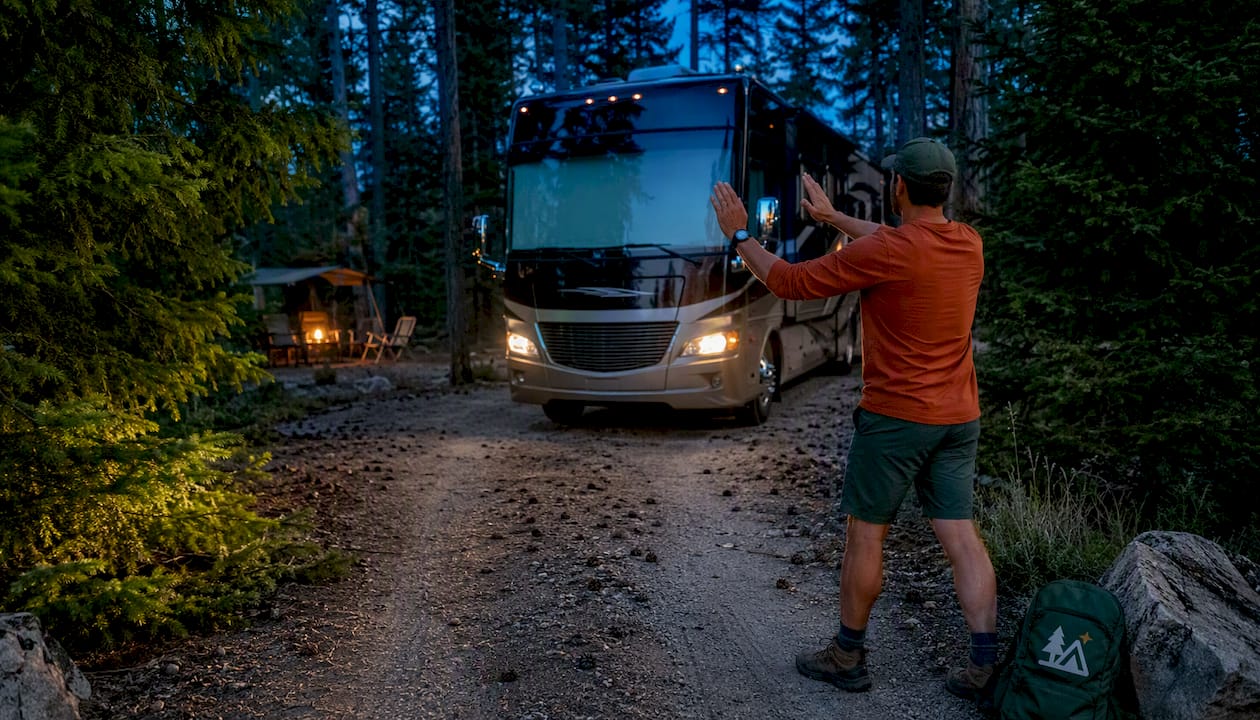
Safety note: Arrive before dark. Campground loops are often narrow and unlit, and maneuvering a large rig after sunset substantially raises the risk of scraping trees, clipping posts, or misjudging a back-in. Build your drive time to reach the campground by late afternoon.
What campground layouts and amenities should RVers expect?
Site types vary more in national parks than at private campgrounds, and knowing what you're booking matters.
Common site layouts:
- Pull-through sites let you drive in and out without reversing — the easiest option for long rigs or solo drivers.
- Back-in sites require reversing into a defined space; most national park sites are back-in.
- Spur sites are angled pull-offs, common in older park loops, and can be tricky for rigs over 25 feet.
- Walk-in or tent-only sites are not suitable for RVs and won't appear in filtered searches.
Amenity categories to check before booking:
- Full hookups (water, electric, sewer): rare inside national parks; more common at private campgrounds near park entrances
- Partial hookups (water and/or electric only): available at select campgrounds like Yellowstone's Fishing Bridge RV Park
- Dry camping / boondocking: no hookups; requires self-sufficient water and waste management
- Dump stations: present at many park campgrounds, but locations vary; confirm before arrival
- Potable water fill stations: usually available at campground loops, but not always at every site
- Restrooms and showers: available at developed campgrounds; vault toilets only at more primitive sites
- Picnic tables and fire rings: standard at most developed sites
- Accessibility features: check the specific site listing on Recreation.gov
Inside-park camping puts you steps from trailheads and ranger programs, but most campgrounds are dry camping or partial hookups. If your rig depends on shore power or daily water refills, plan accordingly or identify the nearest dump station and water fill before you leave home.
What does RV camping in national parks actually cost?
Nightly fees inside national parks are often lower than comparable private campgrounds, but full-hookup RV sites carry a significant premium. Yellowstone illustrates the range well:
| Campground | Nightly Fee | Hookups | Notes |
|---|---|---|---|
| Bridge Bay | $38/night | None | Dry camping; large loops |
| Canyon | $45/night | None | Popular; sells out fast |
| Fishing Bridge RV Park | $94/night | Full hookups | Only full-hookup option in Yellowstone |
Beyond nightly fees, budget for:
- Park entrance fees: Most parks charge a per-vehicle entrance fee, separate from campsite fees.
- America the Beautiful pass ($80/year): Covers entrance fees at all federal lands for one year. If you're visiting two or more fee parks in a year, it pays for itself quickly. It does not cover campsite reservation fees.
- Recreation.gov reservation fee: A modest per-transaction fee applies to most reservations.
- Hookup surcharges: Some campgrounds charge extra for electric or water connections beyond the base nightly rate.
- Dump station fees: A few parks charge for dump station use, especially at standalone stations outside campground loops.
The America the Beautiful pass is worth buying before your first park visit if you plan any multi-park itinerary. Pick one up at any federal fee area or online through the NPS.
Practical RV management tips for national park stays
Plan your fuel, water, and tank capacity before you leave the driveway. Knowing the location of the nearest dump station and potable water fill relative to your campsite is not optional prep — it's the difference between a smooth trip and a stressful one.
RV packing checklist for national park trips:
- Extra fresh water (at least one day's supply beyond your tank capacity)
- Sewer hose, fittings, and elbow adapters
- Leveling blocks and wheel chocks
- Portable solar panel or generator (check park generator hours first)
- Bear-proof containers or approved coolers where required by park rules
- Water pressure regulator (campground water pressure varies widely)
- Surge protector for electrical hookups
- Headlamps and lanterns for low-light setup
Wildlife food storage rules are strictly enforced at many parks. Bear boxes are required at campgrounds in bear country; leaving food, trash, or scented items in an unlocked vehicle or outside a bear box can result in fines and, more importantly, habituated wildlife. Keep your campsite scent-free.
For generator management: check the park's posted hours before you rely on generator power. Some campgrounds restrict generators to a narrow daytime window (often 8 AM–8 PM or shorter), and a few scenic campgrounds prohibit them entirely. If your rig depends on generator power for climate control, verify hookup availability or generator hours before booking.
Pro Tip: When boondocking, stagger high-draw appliances. Run the air conditioner before noon, then switch to fans in the afternoon. Avoid running the microwave and A/C simultaneously if you're on battery only. Small habits like these extend your battery bank by hours.
Which national parks are most RV-friendly?
A few parks consistently work well for RV campers, though each comes with caveats worth knowing.
-
Yellowstone offers multiple campgrounds with large loops and pull-through options. Fishing Bridge RV Park is the only full-hookup campground in the park, and it books out months in advance. Most other Yellowstone loops are dry camping. Check NPS road alerts before arrival, as some roads have vehicle-length restrictions. The Yellowstone Park / West Gate KOA Holiday near the west entrance is a strong full-hookup fallback.
-
Grand Canyon (South Rim) has a large campground at Mather that accommodates RVs up to 30 feet in most loops, with a separate RV-only area. Desert View Campground is first-come, first-served and fits smaller rigs. The North Rim is a different story: the road to the North Rim campground is narrow and challenging for large rigs.
-
Acadia National Park has Blackwoods and Seawall campgrounds, both of which accommodate RVs, but the park's narrow carriage roads and village loop roads are off-limits to vehicles over 20 feet. Plan your sightseeing accordingly.
-
Shenandoah National Park along Skyline Drive has several campgrounds accessible to RVs, though the drive itself has a posted vehicle-length advisory. Loft Mountain and Big Meadows are the most RV-accommodating.
-
Great Smoky Mountains is one of the most visited parks in the country and has campgrounds that accept RVs, but the park has no hookups anywhere. Cades Cove Loop has a vehicle-length restriction. Private campgrounds just outside the park boundaries offer full hookups and are worth booking as a backup.
For any of these parks, check NPS alerts for current road and vehicle-size restrictions before departure. Conditions change seasonally, and a road open in July may be restricted or closed in October.
How to get into a sold-out campground
Yes, you can often get a site after initial sellout. Cancellations happen constantly, and the tactics below work.
- Set Recreation.gov alerts for your target campground and dates immediately after you confirm the site is sold out. The system emails you when a site opens.
- Use third-party cancellation-scanning services that monitor Recreation.gov and send text or email alerts the moment a site becomes available. Have your payment info saved and ready to book within seconds of the alert.
- Search for adjacent campgrounds in the same park or nearby. A different loop or a neighboring campground may have openings, especially for mid-week nights.
- Try rolling-date searches. If your dates are flexible by even one or two days, a Tuesday–Thursday window often has more availability than a Friday–Sunday block.
- Check the morning of arrival. Last-minute cancellations frequently appear the day before or the morning of a stay. If you're already in the area, this is worth a direct check on Recreation.gov.
- Book a private campground as a confirmed fallback while you wait for an alert. A nearby KOA or private campground with full hookups gives you a guaranteed base while you monitor for inside-park openings.
Cancellation-alert services scan Recreation.gov and notify users by text or email when sites open. The key is preparation: have your account logged in, payment saved, and alternate sites bookmarked so you can complete a booking in under 30 seconds when the alert fires.
Pro Tip: Book the private campground first, then hunt for the inside-park site. You'll search with far less stress when you already have a confirmed place to sleep.
Campfire and charcoal grill rules in national parks
Fire regulations vary by park, season, and current fire danger conditions. The NPS sets baseline rules, but individual parks can impose stricter restrictions at any time.
Most developed campgrounds allow campfires only in designated fire rings or metal fire grates provided at the site. Never build a fire on the ground outside the ring, even if the ground looks clear. Charcoal grills are generally permitted at sites with a fire ring or a raised grill grate, but check the specific campground page for any prohibition.
During high fire danger periods, parks can ban all open fires and charcoal grills with little advance notice. This happens frequently in western parks during summer and fall. The NPS posts current fire restrictions on each park's alerts page. Check it within 48 hours of arrival, not just at the time of booking.
A few practical rules that apply broadly across NPS campgrounds: collect only dead and downed wood from the ground (cutting live trees is prohibited), keep fires small and attended at all times, and extinguish completely with water before sleeping or leaving the site. "Cold to the touch" is the standard, not just visually dark. Some parks prohibit bringing outside firewood to prevent the spread of invasive insects; check whether the park requires locally sourced wood.
Finding dump stations inside and near national parks
Most developed national park campgrounds have at least one dump station on-site, but its location relative to your loop matters. Before you arrive, look up the campground map on the NPS park page or Recreation.gov to identify where the dump station is and whether it's accessible to your rig size.
A few things to know: dump stations inside parks are sometimes seasonal, closing after Labor Day or before Memorial Day depending on the park's operating schedule. If you're visiting in shoulder season, call the park to confirm the station is open.
When inside-park dump stations are closed or at capacity, options nearby include:
- Entrance-area visitor centers: Some parks have dump stations near the main entrance, separate from campground loops.
- Private campgrounds near park entrances: Most KOA and private RV parks offer dump station access for a small fee, even if you're not staying there.
- Sanidumps.com and similar directories: These list public and private dump stations by location, useful for planning your route.
- Fuel stations with RV services: Some truck stops and fuel stations along major park approach routes have dump facilities.
Plan your dump schedule around your tank capacity, not your convenience. If you're on a five-day trip with a 40-gallon black tank and two people, you'll likely need to dump at least once mid-trip. Build that stop into your itinerary before you leave.
When is the best time to visit national parks in your RV?
Timing your trip around weather and crowd cycles is one of the highest-leverage decisions you'll make. The answer depends on the park and your rig's climate systems.
Summer (June–August) is peak season at most parks. Campgrounds fill fastest, temperatures are highest, and afternoon thunderstorms are common in mountain parks like Rocky Mountain and Grand Teton. If your RV has adequate air conditioning and you book well in advance, summer works. But expect crowded loops, longer waits at dump stations, and road congestion.
Shoulder seasons (May and September–October) are the sweet spot for most RV campers. Temperatures are moderate, crowds thin out noticeably after Labor Day, and campsite availability improves. Fall color in parks like Shenandoah and Acadia makes October a particularly rewarding time to visit. The tradeoff: some campground loops and amenities close after Labor Day, so verify what's open before booking.
Winter is viable at lower-elevation parks in the Southwest — Joshua Tree, Big Bend, and Saguaro stay accessible and comfortable in winter months when summer heat makes them impractical. Northern and high-elevation parks like Glacier and Yellowstone have limited or no RV-accessible campgrounds open in winter.
Spring (March–May) brings unpredictable weather, especially at elevation. Snowmelt can close roads well into May in parks like Glacier and Rocky Mountain. Check NPS road status alerts carefully if you're planning a spring trip to any mountain park.
One consistent rule: check park alerts for road closures and vehicle-size restrictions before every trip, regardless of season. A road that was open last year may be under construction or restricted this year.
Key Takeaways
Successful national park RV camping comes down to three things: knowing your rig's real dimensions, booking at the right moment, and having a confirmed fallback when inside-park sites are gone.
| Point | Details |
|---|---|
| Measure your full rig first | Bumper-to-bumper length including tow vehicle; towables need roughly 5 feet more clearance than posted site maximums suggest. |
| Book at the correct window | Most NPS campgrounds open reservations six months in advance on Recreation.gov; Yosemite Valley sites follow a five-month window and sell out in minutes. |
| Set cancellation alerts | Use Recreation.gov alerts plus third-party scanning services; have payment saved and alternate sites bookmarked before any alert fires. |
| Check NPS alerts within 48 hours | Road closures, fire restrictions, and vehicle-size bans can change quickly; always verify before departure. |
| Use Campgazer for rig-filtered search | Campgazer lets you filter by rig length, hookup type, and nearby private alternatives across 10,000+ campgrounds in one search. |
The tradeoff most RV campers learn the hard way
There's a version of national park RV camping that looks great on paper: you book the inside-park site, wake up 200 yards from the trailhead, and spend zero time driving to the park each morning. That version is real, and it's worth chasing. But it requires accepting that most inside-park campgrounds are dry camping or partial hookups, that the loops are tighter than you expect, and that the booking window is unforgiving.
The campers who consistently get those sites aren't lucky. They know the exact release time, they have their Recreation.gov account preloaded with payment info, and they've already identified two backup sites in case the first pick disappears in the first 30 seconds. They also know their rig's actual turning radius, not just its listed length, because a 32-foot fifth wheel that technically fits a 35-foot site can still fail the turn into the spur.
The practical preference that holds up across most trips: keep your rig at or under 30 feet if you want the widest access to inside-park loops, and always reserve a nearby private campground as a confirmed fallback before you start hunting for the inside-park site. The fallback removes the desperation from the search, and desperation is what leads to booking a site your rig can't actually navigate.
Plan your national park RV trip faster with Campgazer
Finding a rig-compatible national park site usually means checking multiple park pages, cross-referencing Recreation.gov length limits, and separately searching for private fallbacks. Campgazer does that in one place.
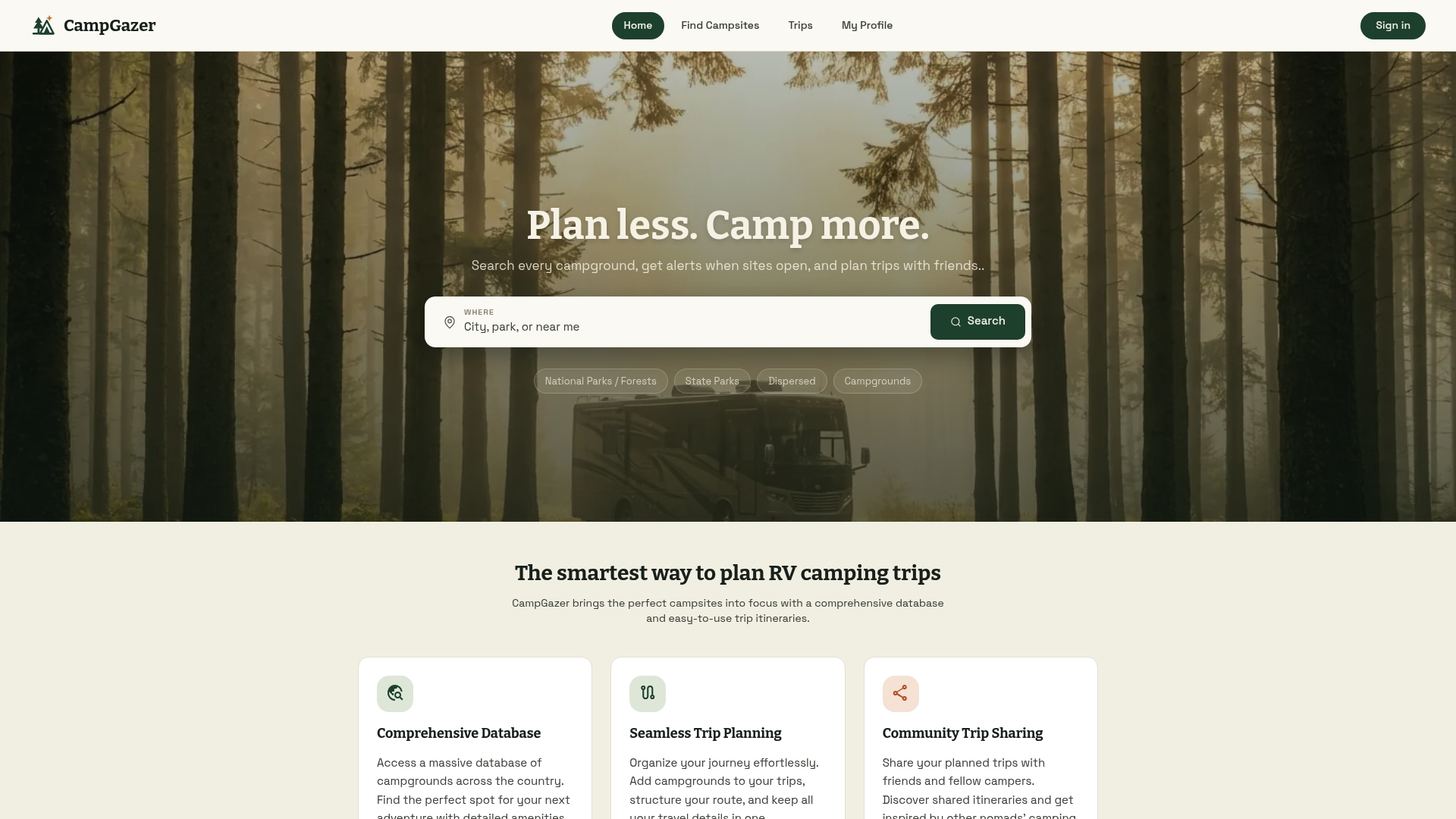
With a database of 10,000+ campgrounds, Campgazer lets you filter by rig length, hookup type, and amenities so you see only the sites your RV can actually use. Set live availability alerts for your target parks, save nearby private campgrounds as backup options on your itinerary, and share your trip plan with family or travel partners. Whether you're targeting a Yellowstone loop or need a full-hookup private alternative near a park entrance, the campsite specs and community-contributed details are already there. Start your rig-profile search at Campgazer and set alerts for your target park before the next booking window opens.
Useful sources for live campground details
Check these sources in the order that fits your planning stage. For the most current road closures or fire restrictions, revisit them within 48 hours of your departure date.
- National Park Service park pages: Best for authoritative campground rules, vehicle-size restrictions, seasonal closures, wildlife storage requirements, and fire regulations. Navigate to "Plan Your Visit" on any park's page.
- Recreation.gov: Best for reservations, site-level photos, max vehicle length by loop, and availability calendars. Use the filter tools to narrow by RV length before browsing dates.
- NPS app (App Store / Google Play): Best for offline park maps and "Where to Stay" info when cell service is limited inside park boundaries.
- Campgazer: Best for aggregated campsite specs across national parks and private campgrounds, rig-length filtering, live availability alerts, and building a full itinerary with fallback options.
- Individual campground pages on Recreation.gov: Always check the specific campground page, not just the park-level page, for generator hours, dump station location, and site-specific length limits.