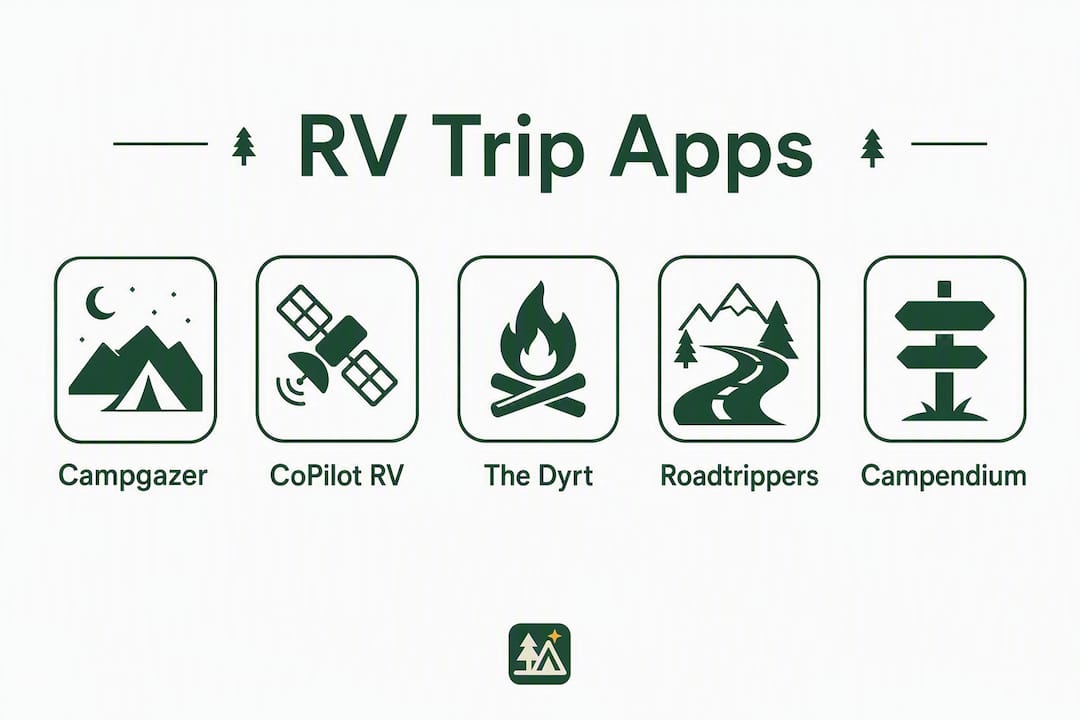
For most U.S. RVers, the best rv trip apps come down to one all-in-one planner, one rig-aware navigation app, and one campsite directory. Here are the five picks that cover every stage of a trip:
- Campgazer — All-in-one campsite search and trip planner with 10,000+ campgrounds, rig-aware itineraries, and collaborative sharing. Free platform. Best all-in-one.
- The Dyrt — Campsite discovery with strong user photos and filtered searches across private and public sites. Freemium. Best for campground discovery.
- CoPilot RV GPS Navigation — Dedicated RV GPS with rig-profile settings and offline maps for strict height and weight avoidance. Paid. Best for rig-aware navigation.
- Roadtrippers — Route inspiration with map overlays for cell coverage and wildfire smoke, plus campground reviews. Freemium. Best for route planning.
- Campendium — Community-driven boondocking directory with honest user-submitted site reports and recent photos. Free. Best boondocking directory.
App categories for RV travel break into three core groups: campsite discovery, navigation and route planning, and road utilities like fuel finders. Knowing which category you're missing makes it much easier to build a stack that actually works on the road.
Table of Contents
- How do the best RV trip apps compare side by side?
- How do you pick the right RV trip apps for your rig and trip style?
- How these apps were selected and evaluated
- Key Takeaways
- What most RV app roundups get wrong
- Campgazer makes it easier to plan your next RV trip
- Useful sources and further reading
How do the best RV trip apps compare side by side?
| App | Best for | Price | Platforms | Offline access | RV-specific features | Campsite database | Reservation support | Collaboration |
|---|---|---|---|---|---|---|---|---|
| Campgazer | All-in-one planning | Free | iOS, Android, Web | Offline campground data | Rig-aware planning, campground specs | 10,000+ private, public, boondocking | Links to booking | Shared itineraries, multi-user |
| The Dyrt | Campground discovery | Freemium | iOS, Android, Web | Offline maps (Pro) | Filters for hookups, rig size | Private + public, large review base | Links out | — |
| CoPilot RV GPS Navigation | Strict rig-aware routing | Paid | iOS, Android | Full offline maps | Rig profile, height/weight avoidance | — | — | — |
| Roadtrippers | Route inspiration | Freemium | iOS, Android, Web | Limited | — | Campground reviews + POIs | Links out | Trip sharing |
| Campendium | Boondocking search | Free | iOS, Android, Web | Partial | — | Community-sourced, free sites | — | — |
| iOverlander | Dispersed camping + services | Free | iOS, Android, Web | Partial | — | Crowd-sourced, global | — | — |
| AllStays | RV-specific POI routing | Paid | iOS | Offline maps | RV POIs, truck stops, rest areas | RV services + campgrounds | — | — |
| RV Trip Wizard | Browser-to-mobile planning | Subscription | iOS, Android, Web | Offline nav (mobile) | Rig-aware routing | Campground database | Links out | — |
| Harvest Hosts / Boondockers Welcome | Unique private-host stays | Membership | iOS, Android, Web | — | — | Private hosts, wineries, farms | In-app (membership) | — |
| Recreation.gov | Federal campground booking | Free | iOS, Android, Web | — | — | Federal/NPS campgrounds | Book in-app | — |
| Google Maps | Supplemental navigation | Free | iOS, Android, Web | Offline maps (limited) | None | POIs only | — | — |
| RV Parky | Quick campground lookups | Free | iOS, Android | — | RVer-focused notes | Community-sourced | — | — |
| Gas Buddy | Fuel stop planning | Free/Premium | iOS, Android, Web | — | — | — | — | — |
Campgazer covers the widest range of trip stages in one place. Its searchable database of 10,000+ campgrounds includes detailed amenity data, rig-related specs, and collaborative itinerary tools that let you plan with a partner or family before anyone leaves the driveway. The free access model means you're not paying a subscription to browse and build a trip.
The Dyrt earns its place as a campground discovery tool because of the quality of its community content: well-structured pages, recent photos, and filters that let you narrow by hookup type or rig size. The Pro tier unlocks offline maps, which matters once you're past reliable cell coverage.
CoPilot RV GPS Navigation is the most focused rig-routing app on this list. You enter your rig's height, weight, and length, and it routes accordingly, avoiding low bridges and weight-restricted roads. Full offline maps mean it works in dead zones. The tradeoff is that it's a navigation-only tool with no campsite database.
Roadtrippers shines at the inspiration stage. Its map overlays for cell coverage and wildfire smoke are genuinely useful for long-haul planning, and the trip dataset behind its route suggestions is large. It's not a navigation replacement, and its offline capability is limited.
Campendium is the go-to for dispersed and free camping. User-submitted reports include hookup notes, cell signal ratings, and recent photos that tell you what a site actually looks like in current condition. Pair it with a reservation-capable app for nights when you need a guaranteed spot.
iOverlander goes further into crowd-sourced territory, listing water sources, propane stops, and dispersed camping points that formal directories miss. It's indispensable for off-grid stretches, though data freshness varies by location.
AllStays is built around the practical needs of RV drivers: truck stops, rest areas, dump stations, and campgrounds all in one map. The iOS-only limitation is a real constraint for Android users.
RV Trip Wizard (also branded as RV LIFE tools) appeals to planners who want to build a detailed itinerary on a browser, then sync it to a mobile app for turn-by-turn navigation. The planning-to-driving handoff is its core strength, though it requires a subscription for full features.
Harvest Hosts and Boondockers Welcome operate as membership networks rather than open directories. Members get access to private overnight stays at wineries, farms, and other host properties. The experience is unique, but the membership fee means it suits frequent travelers more than occasional ones.
Recreation.gov is the authoritative portal for federal campground reservations, covering National Park Service and other public-land sites. Use it to confirm availability and book; it's not a trip planner, but no serious RV app stack is complete without it.
Google Maps handles multi-stop routing and traffic-aware rerouting well, and it's free. It has no rig-profile settings and no campsite database, so it works best as a supplemental tool for finding services along a route rather than as a primary RV navigation app.
RV Parky offers straightforward campground lookups with practical notes from RVers on hookup quality and site spacing. Thin on features, but fast and free for quick checks.
Gas Buddy addresses one of the most overlooked planning variables for RVers: fuel cost and stop placement. Towing a rig cuts range significantly, and Gas Buddy's up-to-date price data helps you plan stops where fuel is cheapest along your route.
How do you pick the right RV trip apps for your rig and trip style?
Start with one rule: choose one all-in-one planner and one navigation app that accepts your rig's dimensions. Everything else fills gaps.
Ask these questions before you download anything:
- What are your rig's height, length, and weight? Apps like CoPilot RV GPS Navigation require accurate specs to route safely around low bridges and weight-restricted roads.
- How much of your route runs through dead zones? If you're heading into remote terrain, offline map downloads are non-negotiable, not a nice-to-have.
- Are you booking reserved sites or finding open spots? Reserved federal campgrounds need Recreation.gov; dispersed camping needs Campendium or iOverlander.
- Are you planning with a group or family? Collaborative itinerary tools (Campgazer, Roadtrippers) let everyone see the plan before you leave.
- What's your budget for apps? Several strong options are free; subscriptions like RV Trip Wizard and AllStays add depth but cost money.
Red flags to watch for when evaluating any app:
- No offline map download option for remote routes
- No rig-profile field (height, weight, length)
- Reviews older than 12 months with no freshness indicator
- Core features locked behind a paywall with no free trial
Suggested app combos by trip type:
- Weekend trip to a state park: Campgazer (search and itinerary) + Google Maps (navigation) + Recreation.gov (reservation)
- Long-haul cross-country: Campgazer (planning) + CoPilot RV GPS Navigation (rig routing) + Gas Buddy (fuel stops)
- Boondocking / dispersed camping: Campgazer (base itinerary) + Campendium or iOverlander (free site discovery) + CoPilot RV GPS Navigation (offline routing)
Pro Tip: For family trips with multiple drivers or co-planners, check out free camping apps built for group coordination before committing to a paid subscription. Several free tools handle collaborative itineraries well.
How these apps were selected and evaluated
Every app on this list was evaluated against four criteria: campsite coverage, RV-specific routing capability, offline usability, and price-to-feature ratio. Apps were tested on actual road conditions and on a laptop browser to check the planning-to-navigation handoff that experienced RVers rely on when switching from desktop planning to mobile driving.
Campsite listings were spot-checked against Recreation.gov for federal sites and against community reports for boondocking entries. Rig-routing claims were verified by entering real rig dimensions and checking whether the app actually avoided low-clearance roads or simply accepted the input without changing route behavior.
The rating components and their approximate weights:
- Campsite coverage (30%): breadth of database, freshness of community content, coverage of public and dispersed sites
- RV-specific routing (25%): rig-profile support, bridge and weight avoidance, accuracy of avoidance
- Offline usability (20%): map download quality, offline campsite data, routing without cell service
- Price and usability (15%): free tier value, subscription cost vs. features unlocked, interface clarity
- Collaboration and community (10%): shared itineraries, multi-user access, community-contributed content quality
This article was last updated in 2026. Reviewer: Kamil.
Key Takeaways
For most U.S. RVers, Campgazer paired with a rig-aware navigation app and a boondocking directory covers every stage of a trip, from initial planning through finding a free overnight spot.
| Point | Details |
|---|---|
| Start with one all-in-one planner | Campgazer's 10,000+ campground database and collaborative itinerary tools cover planning, discovery, and group coordination in one place. |
| Add a dedicated navigation app | CoPilot RV GPS Navigation handles strict rig-profile routing and offline maps for remote stretches where cell service drops. |
| Use a boondocking directory for free sites | Campendium and iOverlander surface dispersed camping options that formal directories miss, especially for off-grid nights. |
| Book federal sites through Recreation.gov | Federal and NPS campgrounds require reservations through Recreation.gov; no other app replicates that booking authority. |
| Campgazer as your planning hub | Campgazer's free platform, rig-aware specs, and collaborative sharing make it the recommended starting point for any U.S. RV trip. |
What most RV app roundups get wrong
Most roundups treat every app as roughly equal and leave you with a list of 15 tools and no clear starting point. The honest answer is that 80% of your trip planning happens in one or two apps, and the rest fill narrow gaps.
The real differentiator isn't features. It's the planning-to-driving handoff. You can build the most detailed itinerary in the world on a laptop, but if it doesn't open cleanly on your phone as a navigable route with your campsite notes attached, you're pulling over to cross-reference two apps in a rest stop. That friction compounds over a two-week trip.
Campgazer addresses this directly by keeping your itinerary, campground specs, and collaborative notes in one place across devices. Pair it with CoPilot RV GPS Navigation for rig-safe routing, and you've covered the two stages where most RVers lose time: finding the right campsite and getting there without a low-bridge detour.
The boondocking category deserves more credit than it usually gets in these roundups. Campendium and iOverlander aren't backup options for when campgrounds are full. For a growing number of RVers, dispersed camping is the primary mode, and community-sourced data on water sources, cell signal, and site conditions is genuinely irreplaceable. The caveat is that community-sourced databases need active moderation to stay accurate. Use them alongside a reservation-capable tool, not instead of one.
One more thing worth saying plainly: Gas Buddy is underused by first-time RVers and overused by experienced ones who forget to check it. Fuel is a major variable in RV trip budgeting. A 40-foot Class A pulling a toad gets roughly 7–10 miles per gallon. Knowing where the cheapest diesel is along your route isn't a luxury. It's basic trip math. For group travel with kids in tow, pairing your app stack with practical road trip planning resources can also help you think through the non-app logistics that make or break a long drive.
Campgazer makes it easier to plan your next RV trip
Most RVers spend hours cross-referencing campground websites, spreadsheets, and three different apps before a trip. Campgazer replaces that with a single platform built specifically for the way RVers actually plan.
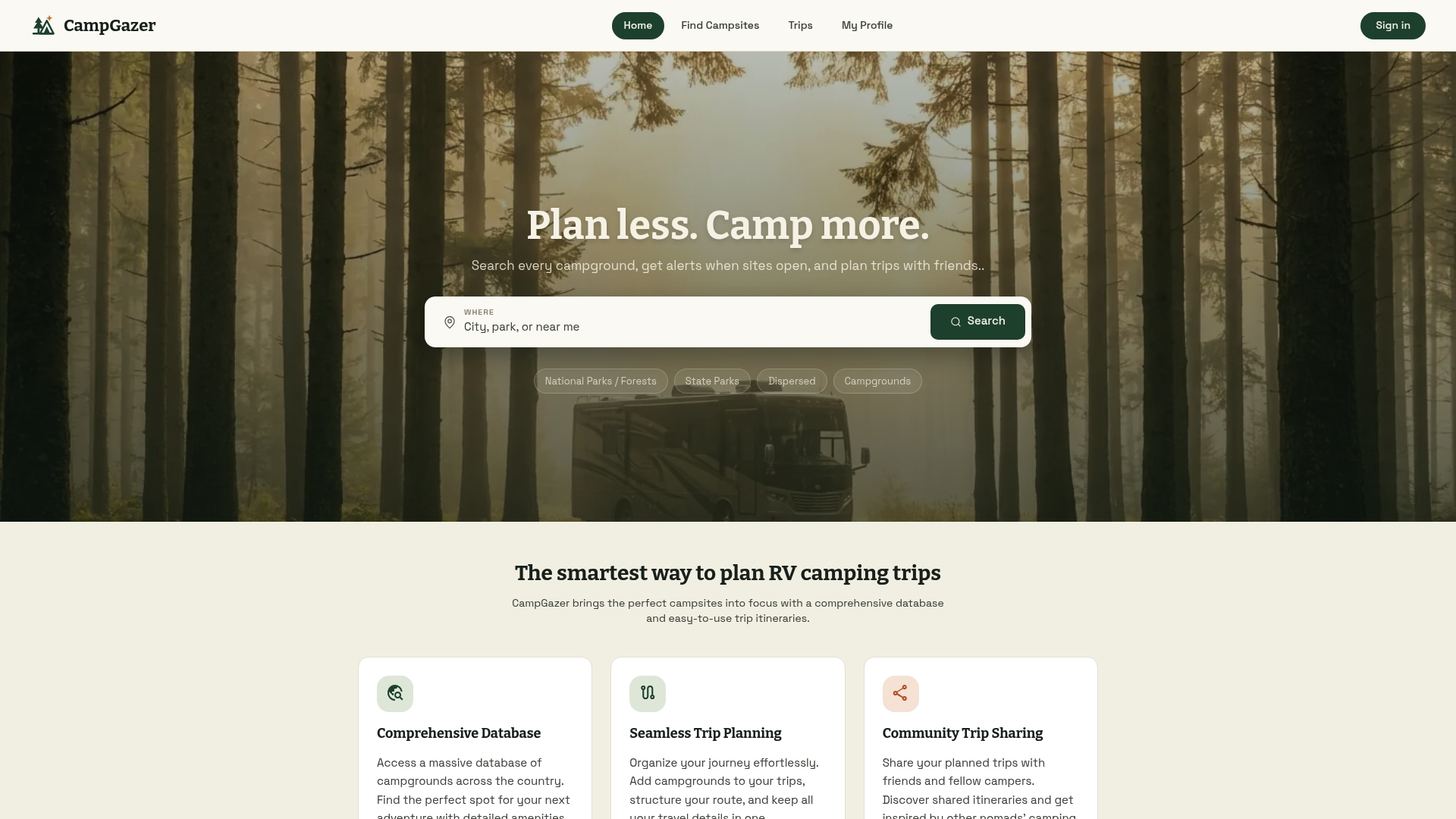
The campground database covers 10,000+ sites across the U.S., each with detailed amenity data, rig-related specs, and community-contributed photos. The trip planner lets you build a full itinerary tied to your rig's dimensions, share it with travel partners, and get live availability alerts before you commit to a route. There's no subscription required to search and plan.
Pro Tip: Build your itinerary in Campgazer, then export your stop list to CoPilot RV GPS Navigation for offline rig-safe routing. You get the planning depth of a full campground database and the routing precision of a dedicated RV GPS, without paying for two subscriptions.
Start with a real campground detail page to see the depth of specs Campgazer provides, then build your first itinerary from there.
Useful sources and further reading
- Campgazer | Plan RV Trips & Check Campsites — The main platform for campground search, rig-aware trip planning, and collaborative itineraries across 10,000+ U.S. campgrounds.
- Best Free Camping Apps for RV Families in 2026 — A focused guide to no-cost apps that support family travel and group coordination, useful if you're building a free-only app stack.
- Roadtrippers vs RV Trip Wizard: Which App Wins? — A direct comparison of the two leading route-planning platforms for RVers weighing planning depth against navigation capability.
- Best RV Route Planner for U.S. RVers: 2026 Guide — In-depth analysis of rig-aware navigation options and route planners, with a checklist for matching an app to your rig type.
- RV Trip Planning: Your Complete 2026 Road Trip Guide — A step-by-step planning workflow for readers who want to go deeper after choosing their apps.
- RV LIFE on Google Play — Reference page for RV Trip Wizard's mobile companion, useful for understanding the browser-to-mobile sync workflow.
Methodology and last-updated date are noted in the evaluation section above. Reviewer: Kamil.