
Which app wins: Roadtrippers vs RV Trip Wizard?
RV Trip Wizard is the stronger tool for serious RV logistics. Roadtrippers is the better pick for discovery, scenic detours, and flexible itinerary building. The two apps solve genuinely different problems, and knowing which one fits your trip style saves you real frustration on the road.
Here is the core contrast at a glance:
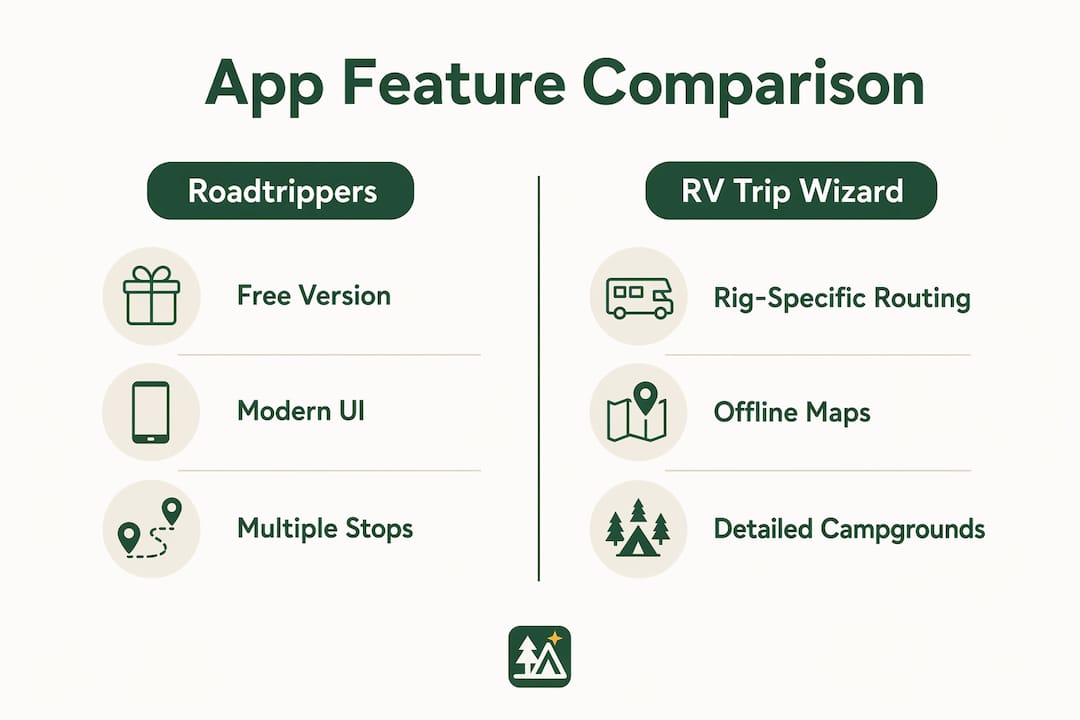
- RV Trip Wizard uses your rig's exact height, weight, and length to generate routes that avoid low bridges, weight restrictions, and roads your RV simply cannot navigate safely
- Roadtrippers gives you access to over 5 million points of interest including quirky roadside stops, filming locations, and off-the-beaten-path attractions that make a trip memorable
- RV Trip Wizard includes a driving radius tool that draws a circle on the map showing every campground and stop within your preferred daily mileage, a feature Roadtrippers does not offer
- Roadtrippers lets you toggle waypoints on and off in real time without deleting them, so you can keep a rainy-day stop in your itinerary without committing to it
- RV Trip Wizard integrates campground reviews from RV Life Campgrounds, with detailed feedback on hookups, water pressure, road conditions, and cell coverage
- Roadtrippers supports live traffic updates and route sharing, features currently absent from RV Trip Wizard
- Many experienced RVers run both apps together: RV Trip Wizard for the safe, rig-aware route, and Roadtrippers for the fun stops layered on top.
If you drive a large Class A, fifth wheel, or travel trailer through unfamiliar states, start with RV Trip Wizard. If your rig is smaller and the trip is more about discovery than logistics, Roadtrippers may feel like a better fit from day one.
Table of Contents
- Feature-by-feature comparison of Roadtrippers and RV Trip Wizard
- How the user interfaces compare in practice
- Which app fits your rig and trip style?
- How to choose between Roadtrippers and RV Trip Wizard
- What Campgazer brings to RV trip planning
- How these apps connect with Google Maps and GPS devices
- Customer support and community engagement
- How current and accurate is the campground data?
- Mobile app performance and offline capabilities
- Key Takeaways
- The app choice that actually matters on travel day
- Campgazer gives you the campground layer both apps are missing
Feature-by-feature comparison of Roadtrippers and RV Trip Wizard
Five apps compete seriously in the RV trip planning space right now. Their strengths split clearly across two categories: logistics-first tools and discovery-first tools.
| App | Best For | RV-Specific Routing | Campground Data | Pricing | Trip Planning Tools | Extras |
|---|---|---|---|---|---|---|
| RV Trip Wizard | Large-rig RVers, multi-day routes | Rig height, weight, length restrictions; driving radius | RV Life Campgrounds integration; detailed hookup reviews | $59/year, 7-day free trial | Route saving, cost tracking, maintenance scheduling | No live traffic; no route sharing |
| Roadtrippers | Discovery-focused travelers, smaller rigs | RV GPS in paid tiers; no rig-dimension routing | Fewer reviews; less granular campground detail | Free tier; ~$35.99/year premium | Waypoint toggling, offline maps (paid), live traffic | Route sharing, Roadpass Pro bundle |
| CampGazer | Community-driven campground research | Itinerary tools tailored to RV specs | 10,000+ campgrounds with detailed amenities and community photos | Free platform | Dynamic itinerary builder, live availability alerts | Community trip sharing, collaborative planning |
| Adventure Genie | Curated trip experiences | Multi-feature travel supports | Curated route data | Not publicly listed | Curated routes, lifestyle tools | Integrated travel conveniences |
| The Dyrt Pro | Campers prioritizing reviews and booking | General camping focus | Extensive user reviews, booking options | Subscription-based | Reservation management, planning tools | Large review database |
RV Trip Wizard strengths:
- Rig-specific routing that accounts for height, weight, and length restrictions
- Driving radius tool for visualizing stops within your preferred daily mileage
- Campground reviews sourced from RV Life Campgrounds, with structured feedback on hookups, roads, and amenities
- Route saving and maintenance scheduling features
- Cost tracking and fuel estimates calibrated to your rig's actual mileage
RV Trip Wizard weaknesses:
- No live traffic updates during navigation
- Interface is functional but dated compared to consumer apps
- No free version; requires a paid subscription to access any features
- Waypoint management becomes unwieldy if you rearrange your itinerary after adding stops
Roadtrippers strengths:
- Generous free tier that works well for shorter, simpler trips
- Intuitive waypoint toggling with automatic rerouting and no deletion of toggled-off stops
- Live traffic updates and route sharing built in
- Offline maps available in the paid version, useful for national parks and remote stretches
- Roadpass Pro bundles Roadtrippers with Togo RV, Campendium, and RVillage for $49.99/year
Roadtrippers weaknesses:
-
No rig-dimension routing; does not account for height, weight, or length restrictions
-
Campground reviews are thinner and less structured than RV Trip Wizard's
-
Finding RV parks requires typing a search term rather than tapping a prominent category button
-
Upgrading to premium at approximately $35.99 per year removes ads, raises the waypoint limit, and unlocks offline maps. If you take shorter trips or rarely need more than a handful of stops, the free version handles the job well.
-
Casual road trippers or those with smaller rigs: Roadtrippers free tier is a reasonable starting point
-
RVers planning complex, multi-day routes with campground stops: RV Trip Wizard's subscription pays for itself quickly in avoided wrong turns and bad campground choices
-
Travelers who want Roadtrippers plus Campendium and RVillage: the Roadpass Pro bundle at $49.99/year is worth comparing against the standalone premium price
Pro Tip: Start with Roadtrippers' free version to get a feel for trip planning apps. If you find yourself bumping against the waypoint limit or needing offline maps, that is a clear signal to upgrade. For any trip involving a large rig, add RV Trip Wizard's seven-day trial before your first serious route.
How the user interfaces compare in practice
Roadtrippers has the more modern interface of the two. The map is interactive and visually polished, the category browsing feels consumer-friendly, and the waypoint toggling works in a way that feels natural to anyone used to Google Maps. Toggling a stop off does not delete it; the app reroutes around it instantly while keeping the stop saved for later. That single design decision makes spontaneous itinerary changes feel effortless rather than stressful.

RV Trip Wizard's interface is older and more utilitarian. It looks closer to a desktop planning tool than a modern mobile app. That said, the functionality underneath the dated skin is genuinely deeper for RV-specific tasks. Route customization works similarly to Google Maps in that you can drag the route line to adjust your path, though some users report the app occasionally refuses to accept certain road choices, requiring a workaround.
One practical difference worth knowing: in RV Trip Wizard, adding waypoints after you have finalized an itinerary can produce unexpected routing behavior, with waypoints shifting in ways that create circuitous detours. The fix is to lock down your stop order before adding any route-level waypoints. Roadtrippers handles this more gracefully with its toggle system, though its drag-to-reroute feature gives less immediate visual feedback than Trip Wizard's equivalent.
- Roadtrippers wins on visual design, ease of first use, and waypoint flexibility
- RV Trip Wizard wins on depth of RV-specific controls once you learn the interface
- Neither app matches Google Maps for live navigation feedback, but both are purpose-built for planning in ways Google Maps is not
Which app fits your rig and trip style?
The right app depends heavily on what your RV is and what you want the trip to feel like.
RV Trip Wizard is the better fit if you:
- Drive a Class A motorhome, fifth wheel, or large travel trailer where bridge clearances and weight limits are genuine concerns
- Plan multi-day routes across multiple states with campground stops built into the route
- Want to track fuel costs, trip expenses, and maintenance schedules in one place
- Travel as a snowbird and need a reliable, repeatable planning workflow for long seasonal routes
- Prioritize campground data quality, including hookup availability, road conditions, and site-specific reviews
Roadtrippers is the better fit if you:
- Drive a smaller rig, van, or car and want to discover interesting stops along the way
- Value a free or low-cost tool for shorter, more spontaneous trips
- Want live traffic updates during navigation
- Plan trips where the experience of the journey matters as much as the destination
- Already use Campendium or RVillage and want everything bundled in Roadpass Pro
Some RVers use both. A practical workflow that experienced travelers recommend is to build the safe, rig-aware route in RV Trip Wizard first, then open Roadtrippers to layer in optional discovery stops, quirky attractions, and scenic detours around the confirmed route. You get the safety net of rig-specific routing without sacrificing the fun of finding unexpected places.
Adventure Genie suits travelers who want curated, pre-built trip experiences with lifestyle conveniences built in. The Dyrt Pro is worth considering if campground reviews and reservation management are your top priority, since its review database is one of the largest available and includes booking tools that neither RV Trip Wizard nor Roadtrippers match.

How to choose between Roadtrippers and RV Trip Wizard
Work through these questions before committing to either app:
Step 1: Assess your rig size. If your RV's height, weight, or length could create routing problems on unfamiliar roads, RV Trip Wizard is the safer starting point. If you drive a smaller rig or a car and road restrictions are not a concern, Roadtrippers' free tier is worth trying first.
Step 2: Define your trip goal. Is the primary goal getting from point A to point B safely with the right campgrounds along the way? That is RV Trip Wizard's core strength. Is the goal building a memorable, discovery-rich itinerary with interesting stops? Roadtrippers is built for that.
Step 3: Count your stops. If you regularly plan trips with more stops, Roadtrippers' free version will eventually require an upgrade. RV Trip Wizard does not impose a waypoint cap in the same way.
Step 4: Consider offline needs. Both apps offer offline maps in their paid tiers. If you frequently travel through national parks or remote areas with no cell service, confirm that whichever app you choose has offline maps enabled before you leave the driveway.
Step 5: Check campground data depth. If detailed campground reviews, hookup specs, and site-level information matter to your planning, RV Trip Wizard's integration with RV Life Campgrounds gives it a clear edge. Roadtrippers' campground data is useful but less detailed.
Step 6: Factor in budget. Roadtrippers' free version costs nothing. RV Trip Wizard requires a paid subscription. If budget is tight and your trips are shorter, start free with Roadtrippers and evaluate whether you need the added depth.
Pro Tip: Use both apps during RV Trip Wizard's seven-day free trial. Plan the same upcoming trip in each app simultaneously. You will know within two or three sessions which interface and feature set matches how you actually think about trip planning.
What Campgazer brings to RV trip planning
Campgazer takes a different approach than either RV Trip Wizard or Roadtrippers. Where those apps center on routing, Campgazer centers on the campgrounds themselves, giving you a searchable database of over 10,000 campgrounds across the country with detailed amenity listings, location data, and community-contributed photos and edits.
The platform's community features set it apart from both competitors. Travelers can share full trip itineraries, post campground photos, and contribute site-level updates that keep the database current. For RVers who want to know what a campground actually looks like before they book, that community layer adds real value that static listings cannot replicate.
Campgazer also supports collaborative planning for groups and families, with live availability alerts and dynamic itinerary tools tailored to your rig's specifications. Both first-time campers and experienced full-timers can use the platform without a steep learning curve.
- 10,000+ campgrounds with detailed amenity and location data
- Community trip sharing and collaborative itinerary planning
- Live availability alerts to catch open sites before they fill
- User-contributed photos, campground edits, and reviews
- Itinerary tools designed around RV specs, not generic road trip planning
Campgazer works best as a campground research and itinerary layer alongside a routing tool. Use it to evaluate specific campgrounds in depth, share your planned route with travel companions, and discover sites that community members have flagged as particularly well-suited for larger rigs.
How these apps connect with Google Maps and GPS devices
Navigation integration is a practical concern that does not always get enough attention in app comparisons.
RV Trip Wizard's mobile app functions as a standalone RV GPS, routing you through fuel stops and campgrounds on roads confirmed safe for your rig's dimensions. It does not rely on Google Maps for navigation, which means you are not switching between apps on travel days. The trade-off is that it lacks Google Maps' live traffic rerouting, so a major accident ahead of you on the highway may not trigger an automatic detour.
Roadtrippers includes GPS navigation built directly into the app, which is convenient for travelers who want one interface for both planning and driving. The paid tiers add RV-friendly GPS navigation, and the app supports live traffic updates that RV Trip Wizard currently does not offer. For drivers who want real-time traffic awareness, that is a meaningful practical advantage.
Neither app replaces a dedicated GPS device for large-rig drivers who prefer a windshield-mounted unit. Both are primarily planning tools that double as navigation apps, rather than navigation apps that happen to include planning features. If you use a Garmin RV GPS or a similar dedicated device, you will likely still want one of these apps for pre-trip planning even if you navigate with hardware on travel days. Roadtrippers also supports Apple CarPlay, which makes it easier to use hands-free while driving without mounting a separate device.
Customer support and community engagement
Support quality differs noticeably between the two apps.
RV Trip Wizard benefits from being part of the broader RV Life ecosystem, which includes RV Life Campgrounds, the RV Life app, and an active online community of RVers who share tips, trip reports, and campground feedback. That community layer means the campground data inside Trip Wizard stays relatively current because real users are actively contributing reviews and updates. Direct customer support is available, though response times vary based on user reports.
Roadtrippers has a larger general user base and benefits from the Togo company's portfolio of apps, including Campendium and RVillage. Campendium in particular has a strong community of campers who contribute detailed campground reviews, and that content now integrates with Roadtrippers through the Roadpass Pro bundle. The Roadtrippers app itself includes photo sharing and destination reviews, giving it a social layer that goes beyond pure logistics.
For travelers who value community-driven content, Campgazer's approach is worth noting. The platform is built around user contributions from the start, with shared itineraries, campground photos, and community edits forming the core of the experience rather than being an add-on feature. That makes it a natural complement to either routing app, particularly for RVers who want peer-sourced campground intelligence before committing to a site.
How current and accurate is the campground data?
Data freshness is one of the most practical concerns for RV trip planning, and the two apps handle it differently.
RV Trip Wizard's campground data draws from RV Life Campgrounds, a dedicated platform where RVers answer structured questions about their stay: hookup quality, road conditions, site size, cell coverage, and more. That structured format produces more consistent and actionable reviews than open-ended comment fields. The integration means Trip Wizard's campground listings tend to reflect real, recent RV-specific experiences rather than generic traveler impressions.
Roadtrippers' campground information is less granular. Reviews exist but are thinner on average, and the structured prompts that make RV Life Campgrounds reviews so useful are largely absent. For finding a campground's location and basic amenities, Roadtrippers works fine. For evaluating whether a specific site can accommodate a 40-foot Class A with slide-outs, the detail level often falls short.
The Dyrt Pro addresses this gap directly. Its review database is one of the largest in the camping app space, with user-submitted photos and detailed campground reports that rival RV Life Campgrounds in depth. If campground research is your primary concern and routing is secondary, The Dyrt Pro deserves a serious look alongside the two main contenders.
Campgazer's community-contributed model keeps its 10,000+ campground listings updated through user photos, edits, and trip reports. For travelers who want a dedicated campground research tool with community-sourced accuracy, that model produces data that reflects how a site actually looks and functions, not just how it was described at launch.
Mobile app performance and offline capabilities
Both apps work on iOS, Android, PC, and Mac, giving you flexibility to plan on a laptop and navigate from a phone or tablet.
Roadtrippers' offline maps, available in the paid version, let you download a map with turn-by-turn navigation for areas with no cell service. National parks are the obvious use case, where spotty coverage is common and the stakes of getting lost are higher. The download process is straightforward, and the offline navigation works without any active connection once the map is saved.
RV Trip Wizard also offers downloadable maps for offline use in its paid tier. The mobile app functions as a full RV GPS, so travel-day navigation does not require a constant data connection once your route is loaded. That said, live traffic updates are not available offline in either app, which is a limitation worth planning around on busy travel days.
App performance on mobile is generally solid for both tools, though RV Trip Wizard's interface translates less elegantly to a small phone screen than Roadtrippers' more modern design. Travelers who do most of their planning on a desktop and then switch to a phone for navigation tend to find RV Trip Wizard's workflow more natural, since the planning side is genuinely better on a larger screen. Roadtrippers' mobile experience is more polished for on-the-go use.
For discovery-focused browsing on a phone, Roadtrippers' map-based interface and category browsing feel more intuitive. For serious pre-trip planning with rig specs, cost tracking, and campground research, the desktop version of RV Trip Wizard is where the tool really earns its subscription fee.
Key Takeaways
RV Trip Wizard is the right tool when your rig's size shapes the route; Roadtrippers is the right tool when the trip's experience shapes the itinerary, and Campgazer adds the campground depth that both apps leave on the table.
| Point | Details |
|---|---|
| RV Trip Wizard for large rigs | Rig-specific routing, driving radius tool, and RV Life campground reviews make it the safer choice for Class A and fifth-wheel travelers. |
| Roadtrippers for discovery | Over 5 million points of interest, live traffic, and intuitive waypoint toggling suit travelers who prioritize scenic and spontaneous stops. |
| Pricing difference | RV Trip Wizard costs $59/year with no free tier; Roadtrippers offers a usable free version and premium at approximately $35.99/year. |
| Dual-app workflow | Many experienced RVers plan the safe route in RV Trip Wizard, then layer in optional stops using Roadtrippers for the best of both tools. |
| Campgazer for campground depth | Campgazer's 10,000+ campground database with community photos and live availability alerts fills the research gap neither routing app fully covers. |
The app choice that actually matters on travel day
Most articles in this space treat the Roadtrippers vs RV Trip Wizard question as a head-to-head where one app must win. That framing misses the point. These tools are not interchangeable, and the real mistake is picking the wrong one for the wrong trip type.
Here is what I see consistently overlooked: RV Trip Wizard's value is not just in the features it has. It is in the mistakes it prevents. A large-rig driver who takes a route flagged as unsafe because their planning app did not account for a 13-foot bridge clearance is not having a bad app experience. They are having a dangerous one. The utilitarian interface and the subscription fee look very different when you frame the tool that way.
Roadtrippers, on the other hand, gets undersold as a "car trip app." Its waypoint toggling system is genuinely one of the best itinerary management features in any trip planning tool, RV-specific or otherwise. The ability to keep a stop in your itinerary without committing to it, and have the app reroute around it instantly if conditions change, is the kind of feature that sounds minor until you are standing in a parking lot deciding whether to push on through rain. That flexibility has real value for any traveler, not just car campers.
The practical recommendation: if you own a large rig, subscribe to RV Trip Wizard and use it as your primary planning tool. Add Roadtrippers' free version for discovery browsing. If you drive a smaller rig or a van, start with Roadtrippers and only add RV Trip Wizard if you find yourself needing the campground depth and rig-specific routing. Neither app is a permanent commitment, and the seven-day trial on RV Trip Wizard makes the evaluation cost-free.
Campgazer gives you the campground layer both apps are missing
Neither RV Trip Wizard nor Roadtrippers was built primarily as a campground research tool. Both find campgrounds along your route, but neither gives you the depth of community-sourced detail that makes the difference between a good site and a frustrating one.
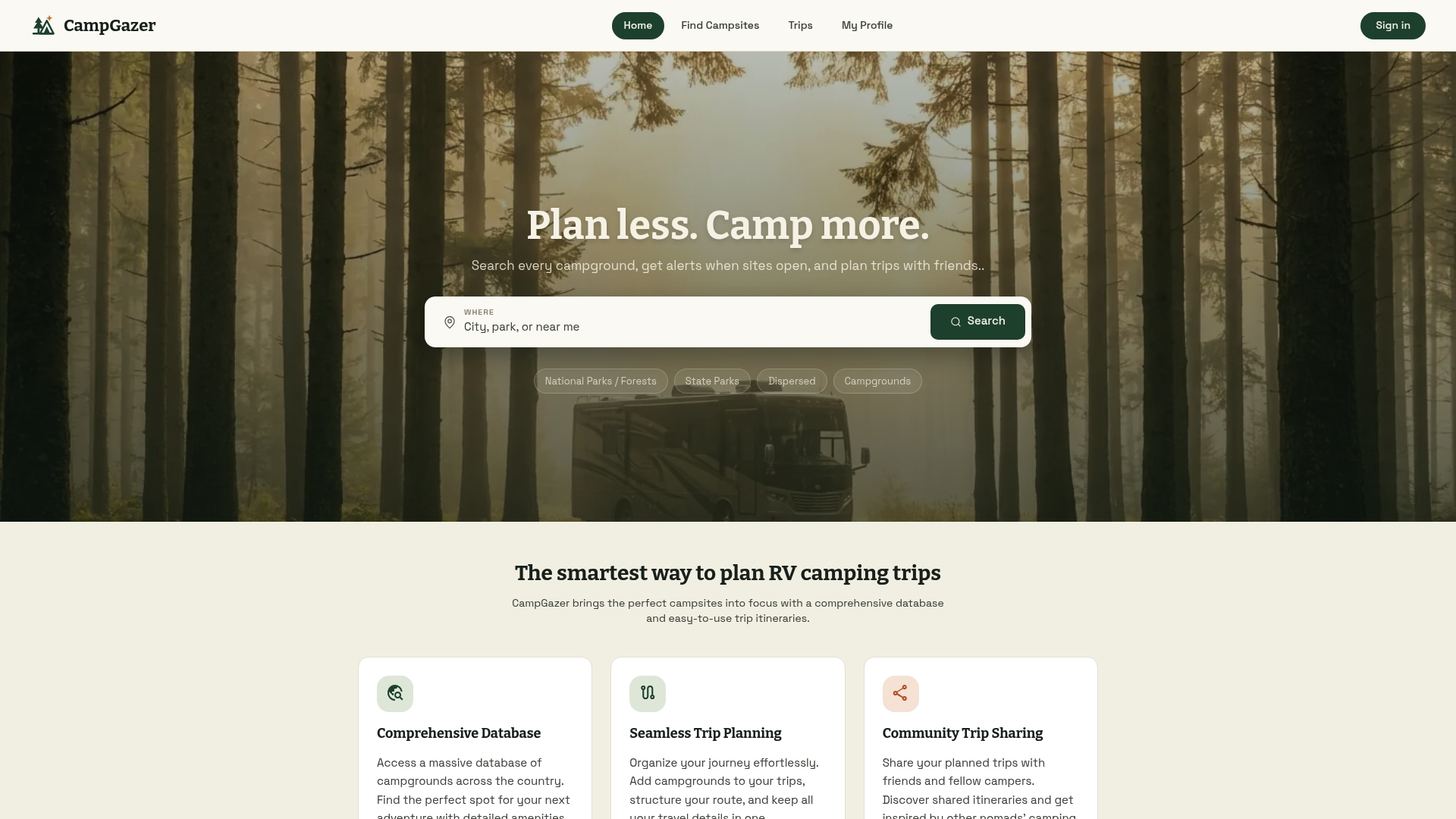
Campgazer fills that gap. The platform covers over 10,000 campgrounds across the country, each with detailed amenity listings, location data, and community-contributed photos and trip reports. You can search by hookup type, site size, and specific amenities, then build a dynamic itinerary around your rig's actual specs. Live availability alerts let you catch open sites before they fill, and the collaborative planning tools make it easy to coordinate with travel companions before you leave home.
If you are planning your next RV trip and want campground data that goes beyond a pin on a map, start your search on Campgazer. Browse detailed site specs for campgrounds like KOA locations across the country, share your itinerary with your travel group, and head out with confidence that your stops are actually ready for your rig.