
Campgazer is the best overall RV route planner for most U.S. travelers. It pairs a searchable database of more than several thousand campgrounds with rig-aware itinerary tools, live availability alerts, and community-shared trip plans, giving you campground depth and routing intelligence in one place. No other planner on this list combines that level of campsite-spec detail with collaborative trip building at no cost to the user.
Quick matchups for specific needs:
- Best for RV-safe routing and low-clearance avoidance: RV Life Trip Wizard
- Best for scenic multi-stop discovery and POI browsing: Roadtrippers
- Best for Good Sam members with membership perks: Good Sam Trip Planner
- Best AI-curated itinerary builder: Adventure Genie
- Best campground review and research directory: The Dyrt
Table of Contents
- Which RV route planners come out on top?
- How to choose the right RV route planner for your rig and trip
- Why Campgazer is our top pick for U.S. RVers
- RV Life Trip Wizard: best for rig customization and RV-safe routing
- Roadtrippers: best for discovery and scenic multi-stop itineraries
- Good Sam Trip Planner: best if you use a Good Sam membership
- Honorable mentions: other useful planners and when to consider them
- How we evaluated and scored these planners
- Do these planners connect with weather and traffic services?
- What kind of customer support do these tools offer?
- How do these planners handle your data and privacy?
- Key Takeaways
- Why the best planner is the one built around the campsite, not just the road
- Campgazer: campground-first planning for your next U.S. RV trip
Which RV route planners come out on top?
The table below compares the six leading RV trip planning tools across the dimensions that matter most when you're choosing a planner for your rig and route.
| Tool | Best for | Price / trial | Platform | RV-specific routing | Campground database & booking | Offline maps | Trip planning features | Fuel cost tools | Ease of use |
|---|---|---|---|---|---|---|---|---|---|
| Campgazer | Campground depth + rig-aware planning | Free | Web | Rig-aware itinerary tools, campsite spec matching | 10,000+ campgrounds; community photos & specs | Not listed publicly | Visual itinerary, multi-stop, collaborative sharing | Not listed publicly | High; community-driven |
| RV Life Trip Wizard | RV-safe routing & vehicle customization | Paid subscription; free trial available | iOS, Android, Web | Detailed vehicle profile, low-clearance avoidance, RV-safe route validation | Integrated campground search | Yes | Multi-stop, route customization | Yes | Moderate; feature-rich |
| Roadtrippers | Scenic discovery & POI-rich itineraries | Free tier; Roadtrippers Plus paid | iOS, Android, Web | Limited RV-specific routing | POI-focused; limited campground booking | Limited | Multi-stop, POI discovery, scenic routing | No | High; intuitive |
| Good Sam Trip Planner | Good Sam members | Free with membership | Web | Low-clearance filters, highway/toll avoidance | Good Sam campground network | Not listed publicly | Point-to-point planning, POI search | No | Moderate |
| The Dyrt | Campground research & peer reviews | Free tier; PRO paid | iOS, Android, Web | Minimal routing features | Large campground directory; user reviews | Yes (PRO) | Basic trip planning | No | High; review-focused |
| Adventure Genie | AI-curated itinerary generation | Free to start | Web, iOS | AI-generated route suggestions | Campground picks via AI | Not listed publicly | Smart stops, AI itinerary | No | High; automated |
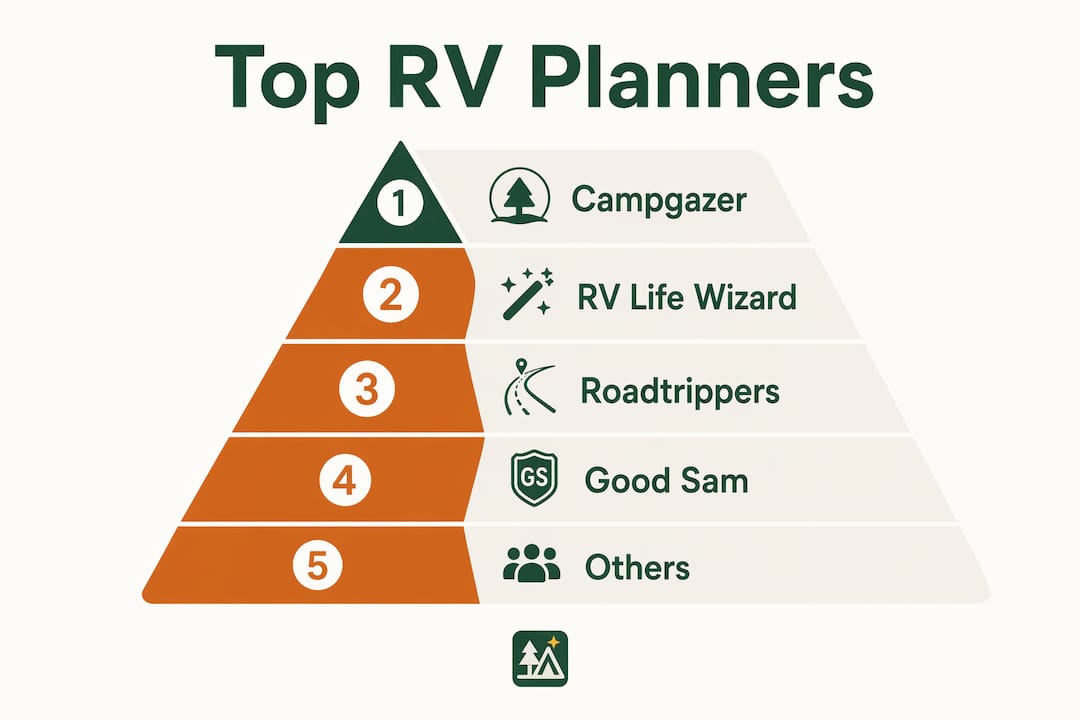
Pros and cons at a glance
Campgazer
- ✅ 10,000+ campgrounds with site-level specs
- ✅ Free to use; no subscription required
- ✅ Collaborative itinerary sharing and community content
- ⚠️ Offline navigation not publicly listed
RV Life Trip Wizard
- ✅ Best-in-class RV-safe routing with vehicle profile inputs
- ✅ Low-clearance and bridge-weight avoidance
- ✅ Free trial available
- ⚠️ Subscription cost; steeper learning curve
Roadtrippers
- ✅ Excellent POI discovery and scenic route inspiration
- ✅ Intuitive, visually appealing interface
- ⚠️ Limited RV-specific routing; not rig-profile aware
- ⚠️ Offline access limited on free tier
Good Sam Trip Planner
- ✅ Tight integration with Good Sam campground network
- ✅ Low-clearance filters and highway-avoidance options
- ⚠️ Most valuable only for active Good Sam members
- ⚠️ Campground data skews toward Good Sam properties
The Dyrt
- ✅ Extensive community reviews and campground photos
- ✅ Offline maps on PRO tier
- ⚠️ Minimal route-planning or rig-profile features
- ⚠️ Better as a research tool than a full trip planner
Adventure Genie
- ✅ Fast, AI-driven itinerary generation
- ✅ Good for travelers who want a starting point quickly
- ⚠️ Less control over rig-specific constraints
- ⚠️ AI suggestions may need manual verification
How to choose the right RV route planner for your rig and trip
Not every planner fits every rig or travel style. Before you commit to one, run through this checklist.
Must-have features for RVers
- Vehicle profile input. Your planner needs to accept your rig's height, length, and weight. Without this, you risk routing onto roads with low bridges or weight-restricted crossings.
- Low-clearance and bridge-weight avoidance. Confirm the tool actively reroutes around known hazards, not just flags them after the fact.
- Campground spec details. Site-level data, including maximum rig length, hookup types, and pull-through availability, prevents arrival-day surprises.
- Offline map access. Cell coverage disappears in rural and mountain areas. Download capability is non-negotiable for boondockers and remote-route travelers.
- Fuel-cost estimation. Tools like RV Axis let you enter your MPG and current fuel price to generate a trip-cost estimate, which is useful for budgeting multi-day routes.
Questions to ask before committing
- How often is the campground database updated? Stale data leads to closed sites and wrong amenity listings.
- Can you import or export your itinerary to a GPS device or share it with travel companions?
- Does the app work offline, and how large are the downloadable map files?
- What is the campground count, and does it include state parks and public lands, not just commercial chains?
Red flags to watch for
- No rig-profile field anywhere in the setup flow
- Campground count under a few thousand, with no public lands coverage
- No offline mode or map download option
- No way to export or print your route
Pricing shapes vary widely. Free tools like Campgazer and the basic Roadtrippers tier handle most planning needs. Subscription tools like RV Life Trip Wizard charge a recurring fee but deliver more precise RV-safe routing. Membership-linked planners like Good Sam's are effectively free if you already hold that membership.
Why Campgazer is our top pick for U.S. RVers
Campgazer solves the two problems that derail most RV trips before they start: finding the right campsite for your rig and building a realistic multi-day route around it.

The campground database covers 10,000+ U.S. campgrounds, from national KOA chains to state parks and regional sites. Each campground page lists site-level specs, including hookup types, pull-through availability, maximum rig length, and community-contributed photos and notes. That detail lets you validate rig fit before you ever leave the driveway.
| Feature | Campgazer detail |
|---|---|
| Campground count | 10,000+ U.S. campgrounds |
| Campsite spec fields | Hookups, length limits, pull-through, amenities |
| Trip planning | Rig-aware itinerary tools, multi-stop routes |
| Collaboration | Community trip sharing, group itinerary planning |
| Availability | Live availability alerts |
| Cost | Free |
The campsite spec pages go beyond a simple amenity checklist. You'll find community photos, user notes, and facility details that help you picture the site before arrival. Coverage spans commercial chains like KOA campgrounds, state parks like Pleasant Creek State Park, and destination sites near major attractions.
A practical example: Say you're planning a five-day loop through the Southwest with a 35-foot fifth wheel. You need pull-through sites, 50-amp hookups, and at least one night near the Grand Canyon. In Campgazer, you search by those specs, pull up matching campgrounds, check the community notes for any low-clearance access roads, then build your itinerary stop by stop. You can share that itinerary with your travel group so everyone sees the same plan.
- Searchable by hookup type, rig length, and amenities
- Community-sourced photos and notes for each site
- Collaborative sharing for group and family trips
- Free to use with no subscription required
RV Life Trip Wizard: best for rig customization and RV-safe routing
If your top concern is keeping a tall or heavy rig off dangerous roads, RV Life Trip Wizard is the specialist tool to consider. It builds a detailed vehicle profile, including height, weight, length, and axle count, then validates every route segment against known low-clearance bridges and weight-restricted roads.
Strengths:
- Detailed vehicle profile with height, weight, and length inputs
- Active low-clearance and bridge-weight avoidance, not just warnings
- RV-safe route validation across the full trip
- Free trial available before committing to a subscription
- Fuel-cost estimation built into route planning
Trade-offs:
- Paid subscription required for full access
- More features means a steeper learning curve than simpler tools
- Campground integration exists but is less deep than campground-first platforms
Choose RV Life Trip Wizard when your rig has unusual height or weight constraints that make routing genuinely risky. Travelers with Class A motorhomes over 13 feet tall or fifth wheels over 40 feet will find the vehicle-profile routing worth the subscription cost. For most Class B and Class C travelers whose primary need is campground discovery and itinerary building, Campgazer covers the job at no cost.
Roadtrippers: best for discovery and scenic multi-stop itineraries
Roadtrippers is built for the traveler who wants to find the best stops along the way, not just the fastest route between two campgrounds. Its POI database covers roadside attractions, scenic overlooks, restaurants, and natural landmarks, making it the go-to tool when the journey itself is the point.

The interface is clean and map-forward. You drop in a start and end point, and Roadtrippers surfaces interesting stops you might not have known to search for. The free tier handles basic multi-stop planning well. Roadtrippers Plus adds more waypoints and enhanced features for frequent users.
Pro Tip: Use Roadtrippers to build your discovery layer first, then cross-reference those stops against Campgazer's campground database to find nearby sites that fit your rig specs. The two tools complement each other well.
Where Roadtrippers falls short for RVers is rig-profile routing. There is no vehicle height or weight input, so the app will not warn you about a low bridge on that scenic backroad it recommends. Use it for inspiration and stop discovery, then validate the actual driving route with a rig-aware tool.
Best for: Travelers who prioritize sightseeing, curated stop lists, and scenic routing over rig-specific safety validation.
Good Sam Trip Planner: best if you use a Good Sam membership
The Good Sam Trip Planner is tightly woven into the Good Sam membership ecosystem. It supports point-to-point route planning, lets you add Good Sam campgrounds directly to your route, and includes filters for low-clearance roads and highway or toll avoidance. You can also search for POIs along the route and adjust for your preferred driving pace.
Strengths:
- Direct integration with Good Sam campground listings
- Low-clearance filters and highway/toll avoidance options
- POI search along the route
- Effectively free for existing Good Sam members
Trade-offs:
- Campground data skews heavily toward Good Sam properties
- Less useful for travelers who camp primarily at state parks or non-affiliated sites
- Web-based interface; mobile experience is more limited
If you already hold a Good Sam membership and camp frequently at Good Sam-affiliated parks, this planner makes sense as your primary tool. The campground data and member discounts are tightly integrated, so you get the most value when you're already inside that ecosystem. Non-members will find the campground coverage narrower than Campgazer or The Dyrt.
Honorable mentions: other useful planners and when to consider them
A few other tools deserve a spot on your radar for specific use cases.
- The Dyrt: The strongest campground review and research platform on this list. Community photos, detailed user reviews, and offline maps on the PRO tier make it excellent for vetting a campsite before you book. It is not a route planner in the traditional sense, but pairing it with a routing tool fills the research gap well.
- Adventure Genie: An AI-assisted planner that generates full itineraries based on your interests, travel dates, and preferred stops. It is the fastest way to get a starting itinerary if you are planning from scratch and want a rough framework to refine. Verify campground picks against a spec-focused platform before finalizing.
- RV Axis: A free online route planner that maps routes, estimates fuel costs based on your MPG and current fuel prices, and suggests daily stops. Useful for quick budget estimates on a new route, though campground data depth is limited compared to dedicated platforms.
How we evaluated and scored these planners
Every tool on this list was assessed against the same criteria. Here is how the weighting broke down.
- RV-safe routing (25%): Does the tool accept a vehicle profile and actively avoid low-clearance bridges and weight-restricted roads?
- Campground coverage (20%): How many campgrounds are indexed? Does coverage include state parks, public lands, and commercial chains?
- Offline navigation (15%): Can you download maps and access your route without cell service?
- Trip-planning features (15%): Does the tool support multi-stop itineraries, visual route building, and itinerary export or sharing?
- Cost and usability (15%): Is the pricing model transparent? Is the interface accessible to first-time users?
- Support and data freshness (10%): How current is the campground data? Is there a support channel for routing or data errors?
Testing involved building sample routes across three rig profiles: a 28-foot travel trailer, a 38-foot Class A motorhome, and a Class B camper van. Routes included a Southwest desert loop, a Pacific Coast run, and a Midwest state-park circuit. Campground pages were spot-checked against known site specs to verify data accuracy.
Do these planners connect with weather and traffic services?
Third-party integrations vary significantly across the tools on this list. RV Life Trip Wizard pulls in traffic data to help you avoid congestion on major corridors, which matters when you're moving a large rig through metro areas during peak hours. Roadtrippers surfaces weather conditions along your route in its Plus tier, giving you a heads-up on mountain passes or coastal weather windows before you commit to a driving day.
Good Sam's planner does not prominently advertise weather or live traffic integration, though its highway-avoidance filter helps you sidestep high-traffic interstates by default. Campgazer's strength is campground data rather than real-time traffic, so pairing it with a navigation app like Google Maps or Waze for live traffic on driving days is a practical workflow many RVers already use.
For weather specifically, most experienced RVers check a dedicated app like Weather Underground or the National Weather Service alongside their route planner rather than relying on a built-in weather layer.
What kind of customer support do these tools offer?
Support quality is one of the least-discussed factors in RV planner comparisons, and it matters most when something goes wrong mid-trip. RV Life Trip Wizard maintains a dedicated FAQ and support center that covers common routing questions, vehicle profile setup, and offline map troubleshooting. That documentation depth is a genuine advantage for new users working through setup.
Roadtrippers and The Dyrt both offer in-app support and community forums where users share workarounds and tips. Good Sam's support is tied to its broader membership service infrastructure, so response times and quality depend on your membership tier.
Campgazer's community-driven model means a lot of the practical knowledge lives in user-contributed notes and shared itineraries. For platform-level support questions, direct contact options are available through the site.
How do these planners handle your data and privacy?
Data privacy is worth a quick check before you hand over your location history, rig specs, and travel itineraries to any platform. As a general rule, tools that require account creation and store your routes in the cloud are subject to their privacy policies regarding data sharing with third parties, including campground partners and advertisers.
RV Life Trip Wizard and Good Sam both operate within established membership platforms that have published privacy policies covering how location and trip data are used. Roadtrippers, as a Harvest Hosts company, follows Harvest Hosts' privacy framework. The Dyrt collects campground review data and location information to power its community features.
Before signing up for any paid subscription, read the data-sharing section of the privacy policy, specifically whether your location history or trip data is shared with advertising partners. Free tools that monetize through advertising tend to collect more behavioral data than subscription tools. Campgazer's free model is supported by affiliate links and sponsored listings rather than behavioral ad targeting.
Key Takeaways
Campgazer is the strongest starting point for most U.S. RVers because it combines a 10,000+ campground database with rig-aware itinerary tools, collaborative planning, and no subscription cost.
| Point | Details |
|---|---|
| Start with rig-profile routing | Confirm your planner accepts height, weight, and length before building any route. |
| Campground depth matters | Look for site-level specs like hookup type and pull-through availability, not just a campground name. |
| Offline maps are non-negotiable | Download maps before entering areas with limited cell coverage, especially on rural or mountain routes. |
| Match the tool to the traveler type | Use RV Life Trip Wizard for tall or heavy rigs; Roadtrippers for discovery-first trips; Good Sam for members. |
| Campgazer covers most needs for free | With 10,000+ campgrounds, rig-aware planning, and community itineraries, it is the recommended first stop. |
Why the best planner is the one built around the campsite, not just the road
Most RV route-planning advice focuses on the routing engine: does it avoid low bridges, does it know your rig's height? Those features matter. But the planning failure I see most often is not a routing error. It is arriving at a campsite that does not fit the rig, or that lacks the hookups you assumed it would have.
The tools that solve that problem are campground-first, not route-first. When you start with a searchable database of site-level specs and build your route around confirmed campsite availability, you eliminate the most common source of trip friction. Routing accuracy is table stakes. Campsite intelligence is the differentiator.
That is why Campgazer earns the top recommendation here. The 10,000+ campground database, the community-contributed specs, and the rig-aware itinerary tools address the actual planning job most RVers face. RV Life Trip Wizard is the right specialist tool when your rig's physical dimensions make routing genuinely hazardous. But for the majority of U.S. RVers planning multi-stop trips with real campsite constraints, starting with campground data and building the route around it is the smarter workflow.
Campgazer: campground-first planning for your next U.S. RV trip
Every planner on this list does something well. But if you want one platform that covers campground research, rig-aware itinerary building, and collaborative trip sharing without a subscription fee, Campgazer is the place to start.
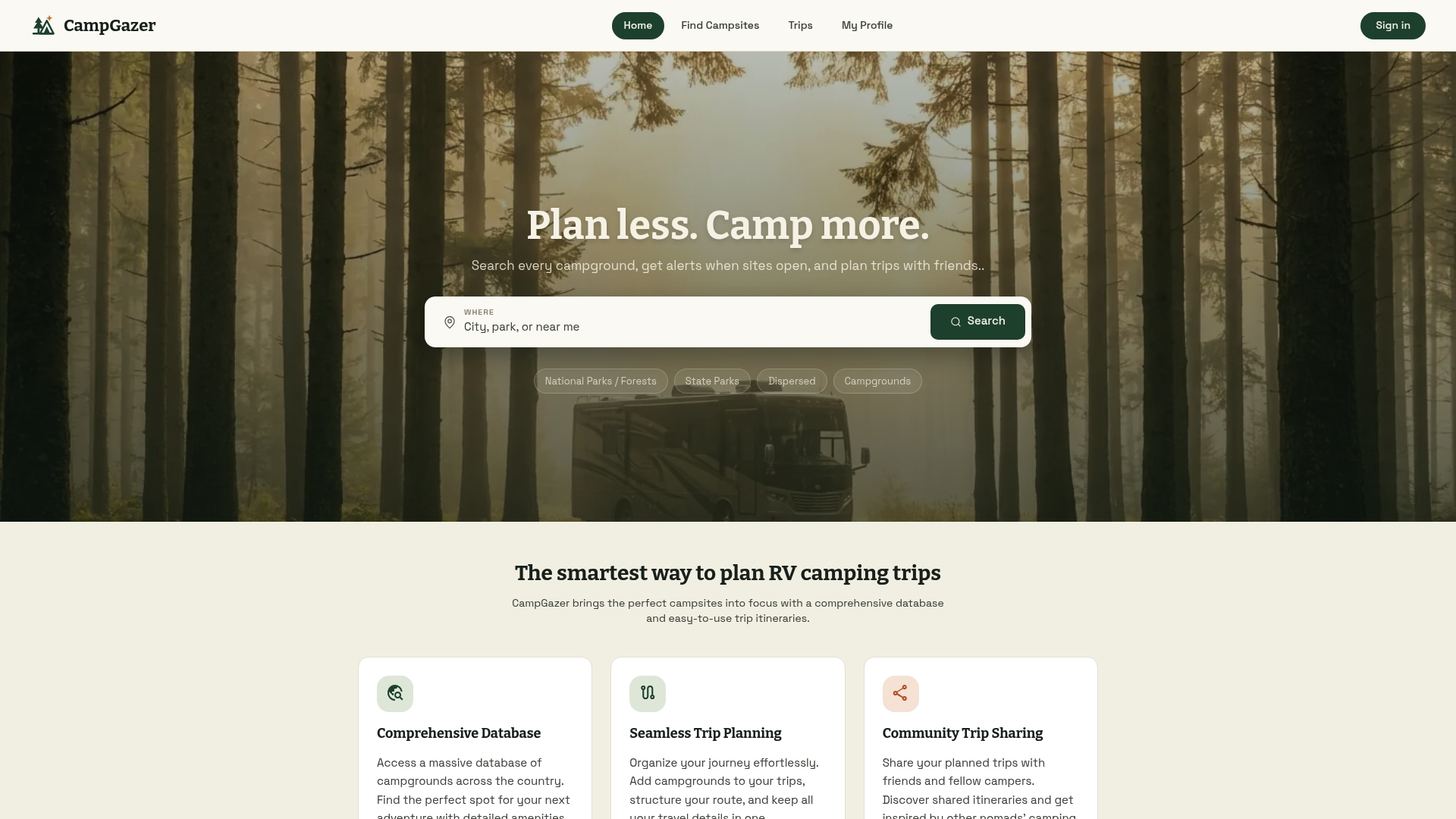
The 10,000+ campground database includes site-level specs for hookups, pull-through availability, and rig length limits, so you can confirm fit before you book. Campsite pages for destinations like the Grand Canyon area and state parks give you the detail you need to plan confidently. Share your itinerary with your travel group, set live availability alerts, and adjust your route as plans change.
Other planners on this list may serve you better for specific needs: RV Life Trip Wizard for precision routing on a tall rig, Roadtrippers for scenic discovery, Good Sam for membership-linked campground perks. Trial any tool that fits your situation. For most RVers, start your trip plan on Campgazer and see how far the campground data takes you.