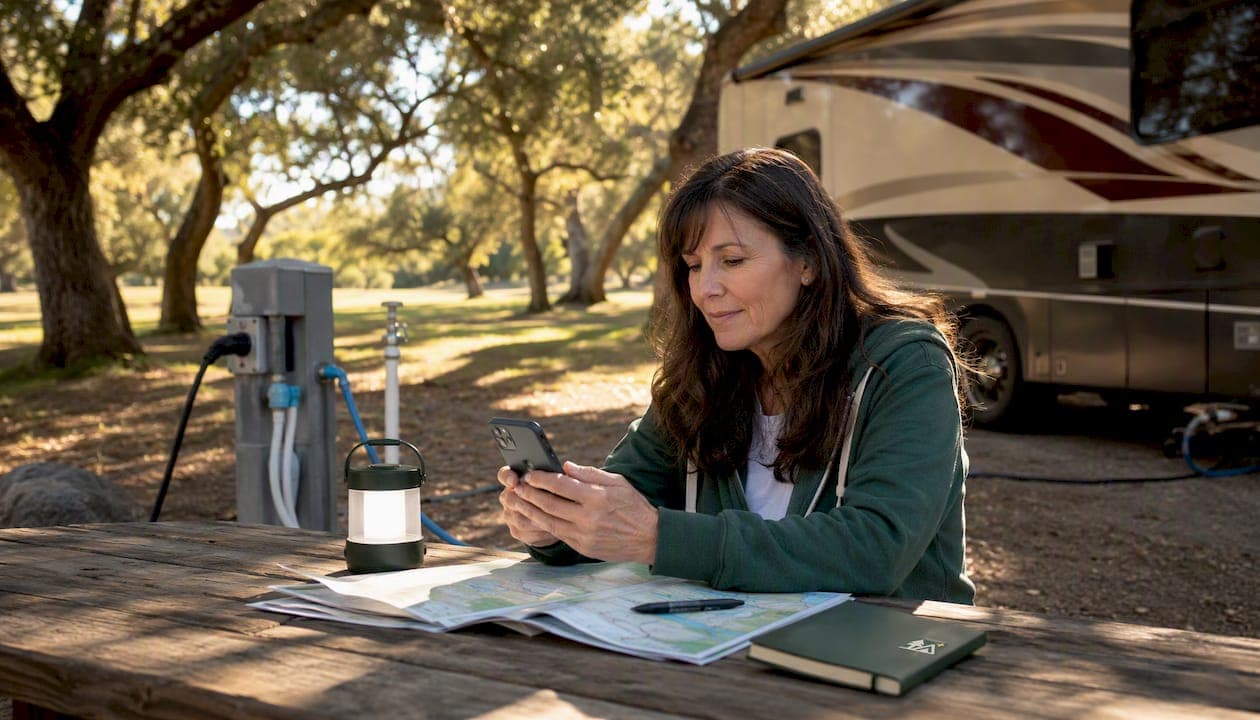
Many U.S. state parks do offer full hookups — water, electric, and sewer at the site — and you can reserve them through each park's official portal, Recreation.gov, ReserveAmerica, or Campgazer. The catch is that not every campground within a park offers them, and availability varies sharply by state, season, and even loop. Knowing where to look and what to confirm before you click "Reserve" is what separates a smooth trip from an unpleasant surprise at the hookup pedestal.
Parks confirmed to offer full-hookup sites include:
- Lake Casa Blanca International State Park (TX) — electric, water, and sewer at the site
- Spring Mill State Park (IN) — full-service sites in a wooded, historic setting
- Delaware Seashore State Park (DE) — coastal access with full hookups
- Lake Cumberland State Resort Park (KY) — resort-style services and on-site sewer
- Bottomless Lakes State Park (NM) — desert scenery with full-hookup sites
- Umbagog Lake State Park (NH/ME region) — lakeside camping with hookup options
- Devils Lake State Recreation Area (OR) — Pacific Coast access with full-hookup sites
These parks are listed by ReserveAmerica as confirmed full-hookup destinations. Before booking any of them, pull up the park's campsite map and confirm the word "sewer" appears at your specific site number.
Pro Tip: A listing labeled "full facility" or "full service" is not the same as "full hookups." Treat it as unverified until the park map explicitly shows a sewer connection at your site.
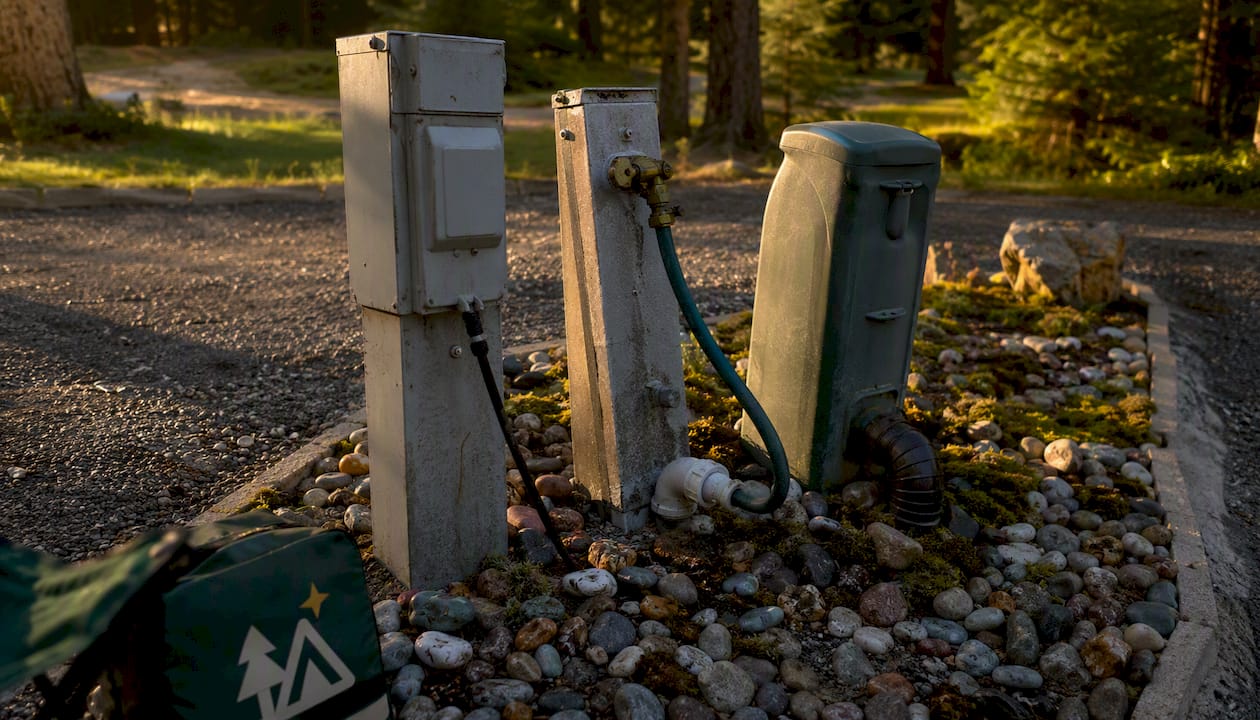
Table of Contents
- What does "full hookups" actually mean for RV campers?
- How do you find and confirm state parks with full hookups?
- Which state parks offer full hookups? Verified highlights by region
- What do full-hookup sites cost, and how do reservation rules work?
- Rig and site checklist: what to confirm before you book
- How Campgazer helps you find and plan full-hookup state park trips
- Key Takeaways
- Full hookups are convenient, but don't let them run your route
- Plan your full-hookup state park trip with Campgazer
- Useful sources and official links for verification
What does "full hookups" actually mean for RV campers?
Full hookups means three utilities delivered directly to your campsite: potable water, an electrical pedestal, and a black-water sewer connection. That last one is the defining element. Without on-site sewer, you have a water-and-electric site, not a full-hookup site.
Parks and reservation platforms use several terms interchangeably, and the differences matter:
- Full hookups — water + electric + sewer at the site pad (the real deal)
- Full service / Full facility (FF) — often water + electric only; KOA notes that "full facility" can mean no sewer connection
- Water & electric (W/E) — no sewer; you'll need a dump station before leaving
- Water only — electric from a generator; no sewer
Electrical details worth confirming
California State Parks' hookup guidance shows that parks often list amp availability at the site level, distinguishing which sites carry 50A service versus 30A. That distinction matters for larger Class A motorhomes and fifth wheels running multiple appliances. A 30A site limits you to roughly 3,600 watts at 120V, while 50A provides up to 12,000 watts across two legs. Most parks offer 30A as standard; 50A sites are fewer and book faster.
The three quick checks before you assume a site is truly full hookup:
- The campsite map shows a sewer icon or the word "sewer" at your specific site number.
- The site-level amenities list on the reservation page includes "sewer" or "full hookup" (not just "full facility").
- Recent photos or reviews confirm visible hookup hardware — a sewer cap or cleanout at the pad.
On-site sewer vs. dump station only
A dump station on the property does not make a site "full hookup." If you're staying multiple nights and relying on your black tank, you'll need to drive to the dump station each time it fills. On-site sewer means the connection is at your pad, and you hook up once for the entire stay. For families, extended trips, or anyone with medical needs, that difference is significant.
Sites with full hookups often also include access to laundry, showers, and Wi-Fi, but verify each amenity individually. A park can offer on-site sewer and still have no Wi-Fi in your loop.
How do you find and confirm state parks with full hookups?
The most reliable approach is a layered verification process. No single source is definitive on its own.
-
Start at the state park's official portal. Texas Parks & Wildlife, for example, categorizes sites as "full hookup campsites (water, electric, sewer)" in a searchable list. Most state portals do the same. Search your target state's park system website and filter by campsite type.
-
Open the park's campsite map. Every major state park reservation page includes a site map. Find your site number and look for a sewer icon or label. If the map only shows water and electric icons, the site is W/E only.
-
Cross-check the reservation listing. On Recreation.gov or ReserveAmerica, click through to the individual site (not just the campground) and read the site-level amenities. The campground summary may say "hookups available" while only a subset of sites actually have sewer.
-
Read recent reviews and photos. Campers who stayed in the last 12 months often post photos of the hookup pedestal and sewer cap. A photo showing a capped sewer stub at the pad is strong confirmation.
-
Call the park office if anything is unclear. Ask specifically: "Does site [number] have an on-site sewer connection, or is there a dump station only?" Also ask about pull-through availability, site length, and whether your rig's slide-outs will clear neighboring sites.
Pro Tip: Screenshot the park's campsite map with your site number circled and add it to your Campgazer trip itinerary. Everyone in your group can see the same verified site details before you hit the road.
Key resources to bookmark for your RV trip planning:
- State park portals (search "[state name] state parks camping reservations")
- Recreation.gov — federal and some state parks
- ReserveAmerica — broad state park coverage
- Campgazer — amenity filters, site-level details, and community confirmations
- Individual park phone numbers (listed on each park's contact page)
Which state parks offer full hookups? Verified highlights by region
The parks below represent confirmed full-hookup options across four regions. Hookup type, amp configurations, and reservation portals are based on available sourced information. Always verify site-level sewer on the park's official page before booking.
| Park | State | Hookup type | Typical amps | Reservation portal |
|---|---|---|---|---|
| Lake Casa Blanca International SP | TX | On-site sewer | 30A/50A | Texas Parks & Wildlife |
| Spring Mill SP | IN | On-site sewer | 30A/50A | ReserveAmerica |
| Delaware Seashore SP | DE | On-site sewer | 30A/50A | ReserveAmerica |
| Lake Cumberland State Resort Park | KY | On-site sewer | 30A/50A | Kentucky State Parks |
| Bottomless Lakes SP | NM | On-site sewer | 30A | New Mexico State Parks |
| Umbagog Lake SP | NH | On-site sewer | 30A | New Hampshire State Parks |
| Devils Lake SRA | OR | On-site sewer | 30A/50A | Oregon State Parks |
| Sesqui SP | SC | On-site sewer (select sites) | 30A/50A | South Carolina State Parks |
Amp configurations are typical for these parks; confirm your specific site before booking.
South
Lake Casa Blanca International State Park sits on a reservoir outside Laredo, Texas. The park offers full-hookup sites with water, electric, and sewer at the pad, making it a practical base for extended stays in South Texas. Book through the Texas Parks & Wildlife reservation system.
Lake Cumberland State Resort Park in Kentucky goes further than most state parks. Resort-style amenities, a marina, and on-site sewer at full-hookup sites make it a destination rather than just a stopover. It's a strong choice for families who want comfort without sacrificing a natural setting.
Midwest
Spring Mill State Park in Indiana pairs full-hookup sites with a restored pioneer village and cave system. The campground offers both 30A and 50A service, and the wooded setting keeps temperatures manageable in summer. Reserve through ReserveAmerica.
Northeast and Mid-Atlantic
Delaware Seashore State Park puts you within walking distance of the Atlantic. Full-hookup sites here book out weeks in advance from Memorial Day through Labor Day, so early reservation is non-negotiable. The park's coastal location means wind and salt air — bring a good awning tie-down kit.
Umbagog Lake State Park on the New Hampshire-Maine border offers a quieter full-hookup experience. The lake setting and loon calls at dusk are the draw; the hookups are the practical bonus that lets you stay longer.
West
Bottomless Lakes State Park in New Mexico delivers red-rock desert scenery alongside full-hookup sites. The lakes themselves are sinkholes fed by underground springs, and the landscape feels unlike anything in the eastern half of the country.
Devils Lake State Recreation Area on the Oregon coast gives you direct access to the Pacific without sacrificing utility connections. The park sits between the ocean and a freshwater lake, and the full-hookup sites fill fast in July and August.
"Sesqui State Park in South Carolina publishes exact site numbers labeled as full service with sewer, alongside counts of full-hookup versus water-and-electric-only sites — a model for how parks should present hookup information. Check the Sesqui camping page to see what thorough site-level disclosure looks like before you book elsewhere."
What do full-hookup sites cost, and how do reservation rules work?
Full-hookup sites at state parks typically cost more per night than water-and-electric or primitive sites, reflecting the added infrastructure. Nightly rates vary by state, park, and season, so the figures below are representative rather than universal.
| Park / State | Approx. nightly rate (full hookup) | Reservation window | Max stay notes |
|---|---|---|---|
| Texas state parks | Varies by park | Up to 90 days out | Varies by park |
| California state parks | Varies by park | Up to 90 days out | Up to 30 nights/year; 15-night peak limit at some parks |
| South Carolina (Sesqui) | Varies by site type | Up to 90 days out | Varies by park |
| Kentucky (Lake Cumberland) | Varies by season | Up to 90 days out | Varies by park |
Always confirm current rates and stay limits on the official park page — rates change seasonally.
Reservation timing
Many state parks open reservations about 90 days in advance, and popular parks with full-hookup sites fill within hours of that window opening for summer weekends. If you're targeting Delaware Seashore, Lake Cumberland, or any coastal or resort-style park between Memorial Day and Labor Day, set a calendar reminder for exactly 90 days before your target arrival date and book the moment the window opens.
Off-peak timing changes the picture considerably. Fall and spring shoulder seasons often have same-week availability at parks that were fully booked all summer. Midweek stays (Sunday through Thursday) also open up sites that weekend campers snap up.
Length-of-stay rules
California State Parks limits some campgrounds to 15 consecutive nights during peak season and sets a 30-night annual maximum at certain parks. Other states have similar rules, though the specifics vary. If you're planning an extended stay, check the park's maximum-stay policy before booking a long run of nights.
Cancellation policies differ between state portals and third-party reservation sites. ReserveAmerica and Recreation.gov each have their own cancellation fee structures, and the park's own portal may differ again. Read the cancellation terms at the time of booking — not after.
Pro Tip: Check for senior and disabled discount programs before booking. Many state park systems offer reduced rates for qualifying campers, and midweek rates at some parks run lower than weekend rates even without a discount.
Rig and site checklist: what to confirm before you book
Arriving to find your rig won't fit the site, or that the 50A pedestal is actually 30A, costs you a night and a lot of frustration. Run through this checklist before you click "Reserve."
- Rig length with tow — Measure your total rig length including the tow vehicle. Many parks list pad length only, not usable length with a tow. A 45-foot pad with a 20-foot truck behind it needs 65 feet of clearance.
Pro Tip: Always add your tow vehicle's length to your rig length before comparing against the park's posted site maximum. Parks routinely give pad length only, and a rig that fits the pad can still block the road behind it.
How Campgazer helps you find and plan full-hookup state park trips
Finding a state park that lists "full hookups" is step one. Confirming that your specific site actually has on-site sewer, matches your rig's length, and fits your travel dates is where most campers lose time. Campgazer's searchable database of 10,000+ campgrounds is built to close that gap.
Here's how the platform supports the full verification and planning process:
- Amenity filters let you search specifically for full-hookup sites, filtering by sewer, amp rating, and site length across the database.
- Site-level detail pages surface campsite maps, hookup hardware photos, and community-sourced confirmations so you can verify sewer at the specific site before booking.
- Trip itinerary tools let you save verified sites, add notes (like your site number and map screenshot), and share the itinerary with travel companions for collaborative planning.
- Live availability alerts notify you when a full-hookup site opens up at a park you're watching, which matters when you're targeting a high-demand park in peak season.
- Community contributions include recent photos, campsite edits, and trip reports from campers who stayed recently — the kind of ground-truth detail that official park pages rarely provide.
A practical workflow: use Campgazer's filters to identify full-hookup sites that match your rig specs, view the site map and recent photos to confirm sewer hardware, save the site to your itinerary, and then head to the official park page or ReserveAmerica to complete the booking. Campgazer surfaces the verification detail; the official portal handles the transaction.
For a live example of how site-level data looks in practice, browse the Ute Lake State Park listing on Campgazer to see how amenities, specs, and site details are presented. You can also check best free camping apps for additional tools that complement your planning workflow.
Key Takeaways
Many U.S. state parks offer true full hookups (water, electric, and on-site sewer), but verifying sewer at the specific site level is the single most important step before booking.
| Point | Details |
|---|---|
| Verify sewer at the site | "Full facility" and "full service" labels don't guarantee sewer; confirm on the park's campsite map. |
| Confirm amp and rig length | Sites vary between 20A, 30A, and 50A; always add tow length to rig length before comparing park maximums. |
| Book early for peak season | Many state parks open reservations 90 days out, and popular full-hookup sites fill within hours for summer weekends. |
| Use layered verification | Cross-check the state portal, reservation listing, site map, and recent reviews before booking any full-hookup site. |
| Campgazer for planning | Campgazer's 10,000+ campground database with amenity filters, site maps, and community confirmations simplifies full-hookup searches and trip itinerary building. |
Full hookups are convenient, but don't let them run your route
There's a version of RV trip planning where every night is locked to a full-hookup site, and the route bends around hookup availability rather than the places worth seeing. That approach works, but it tends to produce trips that feel more like hotel stays than camping.
The campers who seem to get the most out of their rigs are the ones who treat full hookups as a tool rather than a requirement. A few nights at a fully serviced site — tanks topped off, batteries charged, laundry done — creates the margin to spend a night or two somewhere more remote without stressing about tank capacity or power. That rhythm, serviced site then rustic site, tends to produce better memories than a string of identical hookup pads.
That said, full hookups aren't optional for everyone. Families with young children, campers managing medical equipment, and anyone traveling in extreme heat or cold have legitimate reasons to prioritize utility access every night. The calculus is personal. What matters is making the choice deliberately rather than defaulting to full hookups because they're easier to plan around.
Campgazer's collaborative itinerary tools make it practical to build a mixed route, flagging which nights need full hookups and which can flex to a more primitive site. That flexibility, planned in advance rather than improvised at the last minute, is usually what separates a great trip from a stressful one.
Plan your full-hookup state park trip with Campgazer
Searching for full-hookup state park sites across multiple state portals, cross-referencing campsite maps, and tracking availability across peak season is genuinely time-consuming. Campgazer puts 10,000+ campgrounds with detailed amenity filters, site-level hookup data, and community-sourced photos in one place, so you spend less time verifying and more time actually planning the route.
Start by filtering for full-hookup sites on Campgazer, save your top picks to a trip itinerary, and set live availability alerts for high-demand parks. You can share the itinerary with travel partners for collaborative planning, add site map screenshots directly to your trip notes, and adjust the route as availability changes. Whether you're planning a two-week loop through the South or a weekend run to the coast, the database and itinerary tools give you a verified, shareable plan before you leave the driveway. Head to campgazer.com to start your search.
Useful sources and official links for verification
Use these resources to confirm hookup status, check site-level amenities, and complete your reservation.
State park portals:
- Texas Parks & Wildlife — Campsites — searchable campsite type list including "full hookup (water, electric, sewer)"
- California State Parks — Hook-up and RV Camping — amp configurations, stay limits, and site-level hookup guidance
- South Carolina State Parks — Sesqui Camping — example of site-level full-hookup disclosure with exact site numbers
- Florida State Parks — Blackwater River — Florida state park camping reference
- Florida State Parks — Grayton Beach — coastal Florida camping with hookup options
Reservation platforms:
Planning resources:
- Campgazer — full-hookup amenity filters, site maps, community confirmations, and trip itinerary tools across 10,000+ campgrounds
- RV Lifestyle — How to Plan an RV Trip — step-by-step planning guidance including hookup verification
Verification workflow reminder: use the official state park page and campsite map to confirm sewer at your specific site number. Complete the booking on the official portal or ReserveAmerica/Recreation.gov. Record your site number and save a screenshot of the campsite map to your Campgazer itinerary before departure.