For most U.S. campers, Campgazer is the strongest all-around alternative to Hipcamp, offering a searchable database of 10,000+ campgrounds with rig-specific filters, detailed site specs, and free trip-planning tools. If you need something more targeted, here's the quick shortlist by trip style:
- Public lands and permit reservations: Recreation.gov (federal sites, U.S. Forest Service permits)
- Private-land unique stays: Private-land marketplace platforms
- Membership RV overnight networks: Harvest Hosts (farms, wineries, breweries)
- Free and dispersed camping: FreeCampsites.net, iOverlander
- Campground search and RV trip planning: Campgazer
- Glamping and luxury outdoor stays: Glamping Hub
- Community-sourced campground reviews: The Dyrt
Each category below maps to a different camping style. Pick the one that fits your trip, or combine two for a full itinerary.
Table of Contents
- What are the best Hipcamp alternatives by category?
- Platform profiles: what each category actually offers
- How do you choose the right platform for your trip?
- Why Campgazer works best for most U.S. campers
- Named alternatives at a glance
- Key Takeaways
- What we actually recommend, and why
- Campgazer makes RV trip planning straightforward
- Sources and further reading
What are the best Hipcamp alternatives by category?
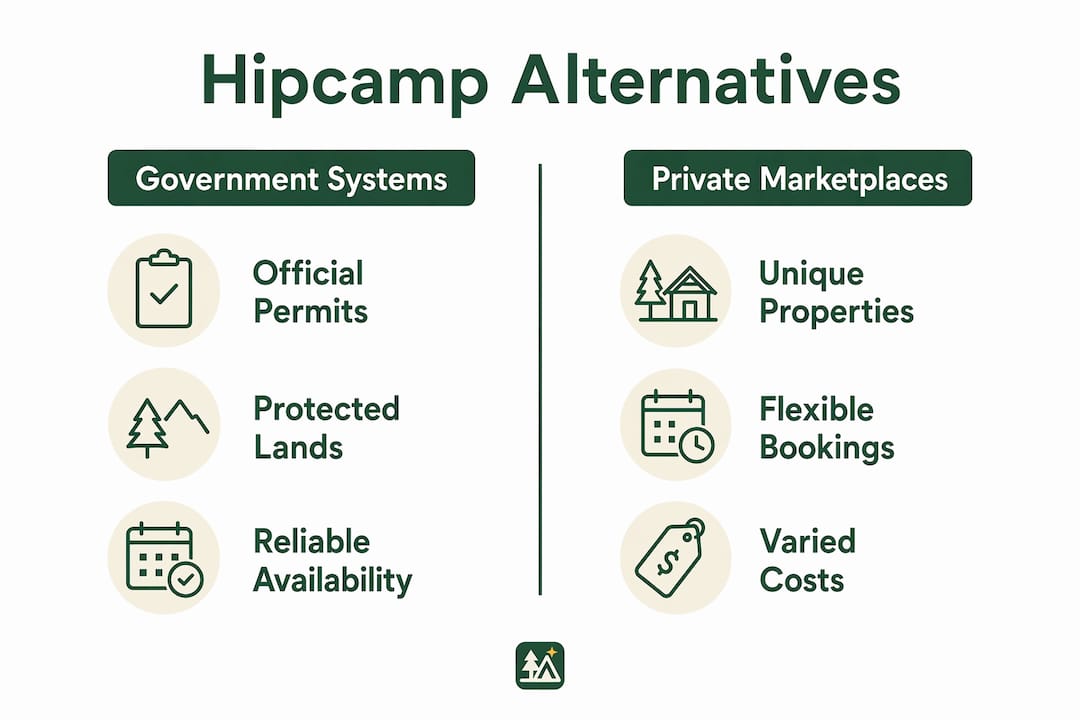
The camping platform market spans several distinct models: government reservation systems, private-land marketplaces, membership networks, dispersed-camping apps, and campground aggregators. Choosing the right one depends on your land type, budget, and rig requirements.
| Category | Best for | U.S. coverage | Booking method | Cost model | RV features | Mobile/offline maps | Community info | Unique perks |
|---|---|---|---|---|---|---|---|---|
| Government reservation systems | Public lands, permits | National parks, federal & state sites | Direct agency booking | Per-stay fees, free permits | Limited rig filters on some systems | App available (Recreation.gov) | Minimal | Official permits, high-demand parks |
| Private-land marketplaces | Unique private parcels | Private farms, ranches, rural land | Request or instant book via platform | Nightly rate + service fee (~15%) | Varies by listing | App, limited offline | Host reviews | One-of-a-kind settings |
| Glamping marketplaces | Luxury outdoor stays | Private glamping properties | Instant or inquiry-based | Premium nightly rates | Not RV-focused | App, limited offline | Guest reviews | Treehouses, yurts, safari tents |
| Dispersed/free-camping apps | Budget and boondocking | BLM, National Forest, NPS dispersed | No booking required | Free or low annual subscription | Basic rig notes | Offline maps (varies by app) | Community-submitted notes | Free public land camping |
| Membership RV networks | RV overnight stays at unique venues | Farms, wineries, breweries, businesses | Contact host or direct request | Annual membership fee | RV-specific (no hookups typically) | Limited | Member reviews | Curated host network |
| Campground aggregators (Campgazer) | RV and tent trip planning | 10,000+ campgrounds, public and private | Links to booking systems | Free to use | Rig filters, site specs, pull-through data | Web-based, growing | Community itineraries and photos | Unified search + trip planner |
| Home-sharing platforms (Airbnb) | Glamping and cabin stays | Nationwide, private properties | Instant book | Nightly rate + service fee | Not RV-focused | App | Guest reviews | Familiar booking interface |
Pro Tip: Use government reservation systems for protected lands and official permits. Use private-land marketplaces or glamping platforms for one-off unique stays. For multi-stop RV routes, Campgazer's unified search and trip planner saves you from juggling five different sites.
Platform profiles: what each category actually offers
Government reservation systems
Recreation.gov runs the federal booking system for national parks, national forests, and many state-managed recreation sites. You book directly through the agency, which means no third-party service fees on top of the campsite rate. The mobile app lets you search real-time availability, save sites, and manage permits in one place.
Quick facts:
- Covers hundreds of federal campgrounds and permit-required wilderness areas
- Booking opens on a rolling window, often 6 months ahead for high-demand parks
- No platform markup; you pay the campsite fee set by the agency
- ReserveAmerica handles reservations for many state park systems under a similar direct-agency model
Great for: Yosemite, Yellowstone, and any site where you need an official permit. Skip it if: You want a private farm stay or a unique off-grid experience on private land.
Private-land marketplaces
These platforms connect you with private landowners who open their property for camping. Specialty stays on farms, vineyards, and rural ranches fall into this category. Service fees typically run around 15% on top of the nightly rate, which is generally moderate depending on the listing.
Quick facts:
- Host verification and listing photos vary widely by platform
- Cancellation policies are set by individual hosts, not the platform
- Booking is usually instant or request-based through the platform's payment system
- Campspace is a newer entrant in this space, focused on European and some U.S. private parcels
Great for: A one-night stay on a working ranch or a weekend at a private lakefront property. Skip it if: You need hookups, a pull-through site, or confirmed rig clearance.
Glamping marketplaces
Glamping Hub specializes in curated luxury outdoor accommodations: safari tents, treehouses, yurts, and cabins. Prices sit at the premium end, and the focus is on comfort rather than self-sufficient camping. Booking is typically instant or inquiry-based.
Quick facts:
- Not designed for RVs or tent-only campers
- Listings include photos, amenity lists, and guest reviews
- Airbnb overlaps here, listing many glamping-style outdoor accommodations alongside standard rentals
- Price range varies widely; expect to pay more than a standard campground
Great for: A special occasion, a couple's retreat, or a first-time "outdoor" experience for non-campers.
Dispersed and free-camping apps
FreeCampsites.net is a free, community-submitted directory of no-cost camping spots on BLM land, National Forest, and other public areas. iOverlander covers similar ground with a stronger focus on overlanding routes and international destinations. Both rely on user-submitted notes, which means accuracy varies.
Quick facts:
- FreeCampsites.net is free to use; no app, web-only
- iOverlander offers a paid subscription tier with expanded features
- Community notes include cell signal ratings, road conditions, and site descriptions
- No booking required for dispersed camping; first-come, first-served
Great for: Budget campers, boondockers, and vanlifers who want free nights on public land. Skip it if: You need hookups, a reservation guarantee, or a large rig with clearance requirements.
Pro Tip: Always cross-check dispersed camping notes with the relevant BLM field office or U.S. Forest Service district website before you go. Community data can lag behind seasonal closures or new permit requirements.
Membership RV networks
Harvest Hosts is the best-known membership network in this category. Members pay an annual fee and gain access to a curated list of farms, wineries, breweries, and other businesses that host RV overnight stays at no additional charge. There are typically no hookups, so a self-contained rig is required.
Quick facts:
- Annual membership fee required (pricing is publicly listed on the Harvest Hosts site)
- Hosts are vetted businesses, not random private landowners
- No per-night fees beyond the membership; some hosts appreciate a purchase
- Best suited for Class A, B, and C motorhomes and self-contained trailers
Great for: RVers who want unique overnight stops between destinations without paying nightly campsite fees. Skip it if: You need full hookups, a dump station, or a multi-night stay in one place.
Campground aggregators and home-sharing platforms
Campgazer sits in this category but goes further than a simple directory. With 10,000+ campgrounds in its searchable database, it covers both public and private campgrounds across the U.S. and adds rig-specific filters, site-level specs, and a trip planner. Airbnb, by contrast, lists outdoor accommodations alongside standard rentals but lacks rig filters and campground-level detail.
The Dyrt is a community-driven campground review app with a large user base and offline map capability, making it useful for dispersed camping research. It sits between a pure review platform and a booking tool.
Quick facts (Campgazer):
- Free to use; no subscription or per-booking fees
- Campground pages include site specs, hookup types, pull-through availability, and community photos
- Trip planner supports multi-stop itineraries with rig-size filtering
- Community itineraries let you see how other campers have routed similar trips
How do you choose the right platform for your trip?
Work through this checklist before you commit to a platform or a booking.
- Define your land type. Public land (national park, state park, BLM, National Forest) or private land? Government systems handle the former; marketplaces and aggregators handle the latter.
- Confirm your booking need. Do you need a guaranteed reservation, or are you comfortable with first-come, first-served? High-demand parks require advance booking through Recreation.gov or ReserveAmerica.
- Set your cost tolerance. Free dispersed camping costs nothing beyond gear. Private-land platforms add service fees. Membership networks require an upfront annual fee. Campgazer is free to search and plan.
- Check your rig requirements. What's your rig length? Do you need full hookups, a pull-through site, or a dump station? Platforms without rig filters can leave you guessing.
- Assess offline map and community info needs. Heading into areas with no cell signal? You need a platform with offline maps or downloadable data.
Questions to ask before you book:
- Is the host verified, and are there recent photos of the actual site?
- What is the cancellation policy, and who processes the payment?
- Does the listing confirm exact GPS coordinates and road access for your rig?
- Are hookups listed with amp ratings, or just noted as "available"?
Red flags to watch for:
- No photos, or photos that don't show the actual campsite
- Cancellation policy that defaults to "no refunds" with no explanation
- Host contact only, with no secure payment through the platform
- No mention of rig length limits or road surface type
Pro Tip: For high-demand parks like Yosemite or Glacier, set a calendar reminder for the exact booking window opening date. Recreation.gov releases many sites 6 months in advance to the day, and popular sites fill within minutes.
Why Campgazer works best for most U.S. campers
Most campers aren't looking for just one thing. You want to search campgrounds, check site specs, plan a multi-stop route, and confirm your rig fits before you drive three hours to find out it doesn't. That's exactly the gap Campgazer fills.
The platform's searchable database covers 10,000+ campgrounds across the country. Each campground page includes site-level detail: hookup types, pull-through availability, rig length limits, and amenity lists. You can filter by rig specs from the start, which cuts out the guesswork that plagues broader platforms.
What Campgazer gives you:
- Rig-size and amenity filters across 10,000+ campgrounds
- Site-level specs including hookup types, pull-through vs. back-in, and max rig length
- Multi-stop trip planner with custom itinerary building
- Live availability alerts so you don't miss a cancellation opening
- Community-contributed photos and trip notes for real-world context
- Collaborative planning tools for group and family trips
- Free to use, with no per-booking fees or subscription required
Consider a practical example: you're planning a 7-day RV loop through the Smokies and want to mix KOA nights with state park stops. You can search Campgazer for campgrounds along your route, filter by your rig length, check hookup availability at each stop, and build the full itinerary in one place. The Pigeon Forge / Gatlinburg KOA Holiday page, for instance, shows site specs and amenities so you know exactly what you're pulling into.
Campgazer is free to use. There's no membership fee and no per-stay charge. The platform is supported through affiliate referrals and sponsored listings, which keeps the search and planning tools open to everyone.
Named alternatives at a glance
Here's a quick reference for each platform the SERP consensus highlights as a Hipcamp substitute:
- Recreation.gov: Federal and state-managed campgrounds and permits. Direct agency booking, no third-party markup. Best for national parks and wilderness permits.
- ReserveAmerica: State park reservation system used by dozens of states. Similar direct-booking model to Recreation.gov. Check your target state's park system to confirm which platform it uses.
- Glamping Hub: Curated luxury outdoor stays. Treehouses, yurts, safari tents. Not RV-focused; best for special occasions.
- iOverlander: Community-sourced camping spots with a strong overlanding and international focus. Paid subscription tiers. Useful offline maps for remote routes.
- FreeCampsites.net: Free, web-only directory of user-submitted no-cost camping spots. No app. Best for budget campers who want a zero-cost starting point.
- Harvest Hosts: Annual membership network for RV overnight stays at farms, wineries, and breweries. Self-contained rigs only. No per-night fees beyond membership.
- Campspace: Private-land camping marketplace with a growing U.S. presence. Host-verified listings, nightly rates plus service fees.
- The Dyrt: Community-driven campground reviews with offline maps. Product directories highlight it as one of the more active review communities for dispersed camping research.
- Airbnb: Broad home-sharing platform that includes glamping cabins, treehouses, and outdoor stays. Familiar booking interface but no rig filters or campground-level specs.
Before you head out, make sure your rig is ready. Knowing your hookup needs and sewer setup in advance helps you filter sites accurately. A good starting point is this guide to RV support gear that covers what to bring for different site types.
Key Takeaways
Campgazer is the strongest all-around Hipcamp alternative for U.S. campers who want unified campground search, rig-specific filters, and free trip-planning tools in one place.
| Point | Details |
|---|---|
| Match platform to land type | Government systems (Recreation.gov, ReserveAmerica) for public lands; private-land platforms for unique stays. |
| Free options exist | FreeCampsites.net and dispersed camping on BLM/National Forest land cost nothing beyond your gear. |
| RV campers need rig filters | Only platforms with site-level specs (hookups, pull-through, rig length) prevent costly last-minute surprises. |
| Membership networks suit frequent RVers | Harvest Hosts pays for itself quickly if you travel regularly and run a self-contained rig. |
| Campgazer covers the most ground | 10,000+ campgrounds, rig filters, trip planner, and community itineraries, all free to use. |
What we actually recommend, and why
The conventional wisdom on camping platforms tends to treat Hipcamp as the default "interesting" option and everything else as a lesser substitute. That framing misses the point. Hipcamp is a private-land marketplace with a service fee model. It's genuinely good for a one-off unique stay on a farm or a scenic private parcel. But it was never designed to be a comprehensive campground search tool, and it doesn't help you plan a multi-stop RV route or confirm your rig fits a specific site.
The campers who get the most out of their trips tend to use a layered approach: a government system for permit-required parks, a campground aggregator like Campgazer for the bulk of their route planning, and a membership network or private-land platform for the nights they want something different. That combination covers public lands, private land, and unique stays without paying a 15% service fee on every booking.
Budget campers and dispersed-camping enthusiasts are underserved by most roundups, which focus on paid platforms. FreeCampsites.net and BLM dispersed areas are genuinely viable for self-sufficient campers, and the community notes on apps like The Dyrt add real-world context that official agency sites don't provide.
The recommendation for Campgazer as the primary planning tool comes down to one practical reality: most U.S. campers stay at established campgrounds, not private parcels. A platform built around campground-level data, rig filters, and trip planning serves that majority better than a private-land marketplace does.
Campgazer makes RV trip planning straightforward
Searching 10,000+ campgrounds with rig-specific filters and site-level specs is exactly what most RV trip planners need before they ever contact a host or click "book." Campgazer gives you that search layer for free, with campground pages that show hookup types, pull-through availability, max rig lengths, and community photos so you arrive knowing what to expect.
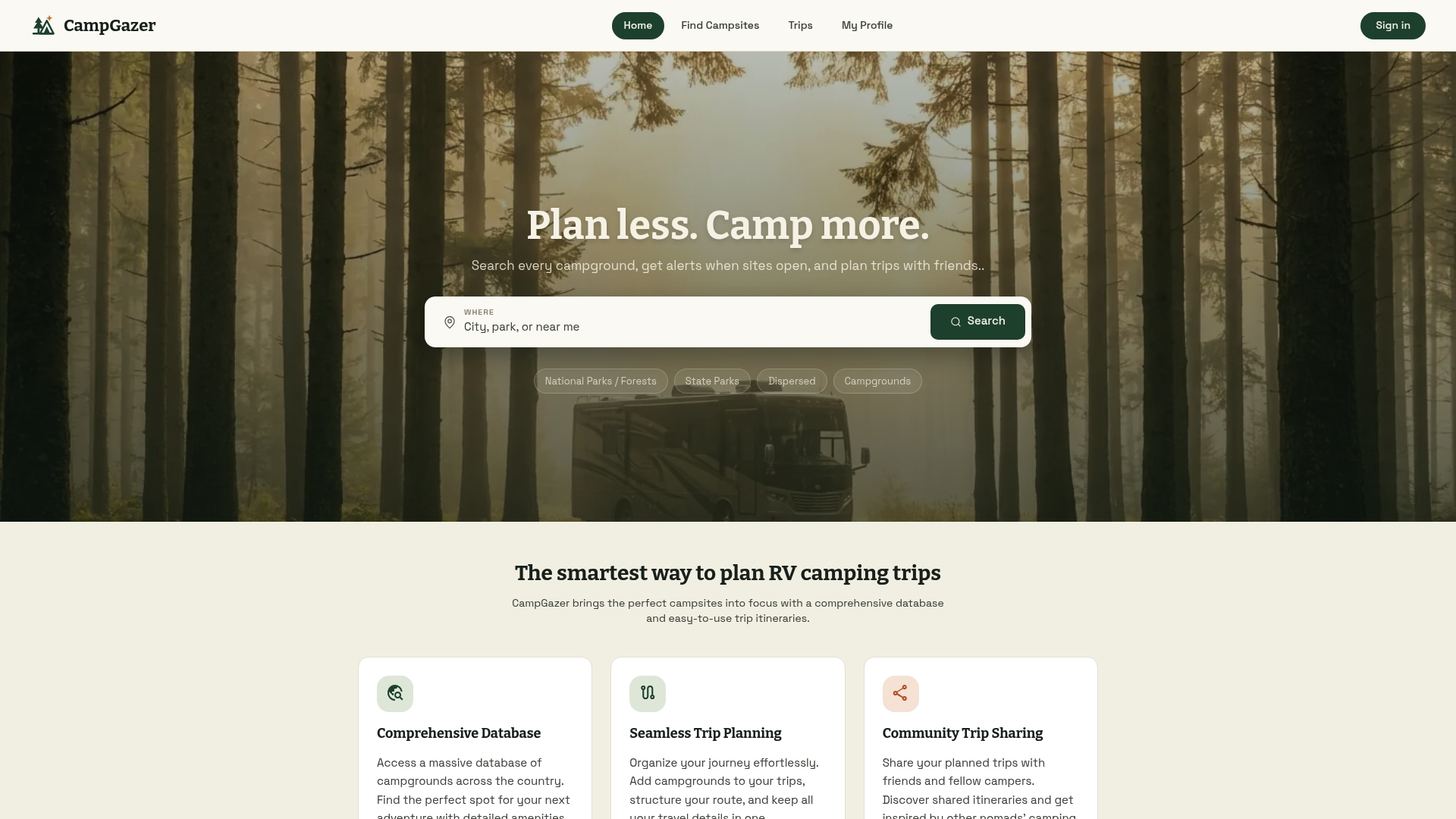
Two steps to get started: search a campground along your planned route, then use the trip planner to build a multi-stop itinerary around your rig specs. The Kerr Lake State Recreation Area page is a good example of the detail level you'll find across the database. For a popular KOA stop, the KOA Kampground page shows site specs and amenities side by side. Start your search at Campgazer.com and build your next trip from there.
Sources and further reading
- Recreation.gov mobile app: Official federal campground and permit booking system; use this for national parks, wilderness permits, and federal recreation sites.
- THOR Industries: Alternative Campsites Guide: Overview of private agritourism and specialty stay options for RVers.
- CB Insights: Hipcamp alternatives overview: Analyst-level breakdown of camping platform business models and market categories.
- Product Hunt: Hipcamp alternatives: Community-sourced list of niche and emerging camping platforms.
- Campgazer: Unified campsite search and trip planner: Primary campground search, rig filters, and trip-planning tools.
- RV Levitator: Must-have RV support gear: Practical gear checklist for confirming site hookup and sewer needs before booking.
- RV Levitator: Sewer hose support options: Companion resource for RVers evaluating full-hookup vs. dry-camping sites.
For permit windows and seasonal closures, always verify directly with the relevant agency (U.S. Forest Service, BLM, National Park Service) rather than relying on third-party platform data alone.